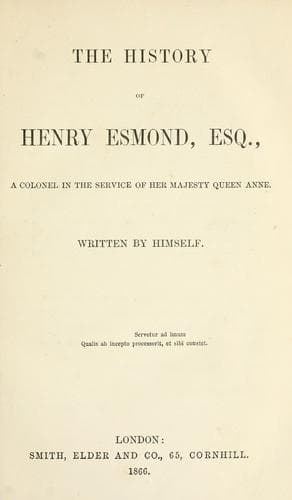
The History of Henry Esmond, Esq., a Colonel in the Service of Her Majesty Queen AnneThackeray, William Makepeace
History
The History of Henry Esmond, Esq., a Colonel in the Service of Her Majesty Queen Anne
Thackeray, William Makepeace
Great Britain -- History -- Anne, 1702-1714 -- Fiction; Historical fiction
The fellow in the orange-tawny livery with blue lace and facings was
in waiting when Esmond came out of prison, and, taking the young
gentleman's slender baggage, led the way out of that odious Newgate, and
by Fleet Conduit, down to the Thames, where a pair of oars was called,
and they went up the river to Chelsey. Esmond thought the sun had never
shone so bright; nor the air felt so fresh and exhilarating. Temple
Garden, as they rowed by, looked like the garden of Eden to him, and
the aspect of the quays, wharves, and buildings by the river, Somerset
House, and Westminster (where the splendid new bridge was just
beginning), Lambeth tower and palace, and that busy shining scene of the
Thames swarming with boats and barges, filled his heart with pleasure
and cheerfulness--as well such a beautiful scene might to one who had
been a prisoner so long, and with so many dark thoughts deepening the
gloom of his captivity. They rowed up at length to the pretty village
of Chelsey, where the nobility have many handsome country-houses; and
so came to my Lady Viscountess's house, a cheerful new house in the
row facing the river, with a handsome garden behind it, and a pleasant
look-out both towards Surrey and Kensington, where stands the noble
ancient palace of the Lord Warwick, Harry's reconciled adversary.
Here in her ladyship's saloon, the young man saw again some of those
pictures which had been at Castlewood, and which she had removed thence
on the death of her lord, Harry's father. Specially, and in the place of
honor, was Sir Peter Lely's picture of the honorable Mistress Isabella
Esmond as Diana, in yellow satin, with a bow in her hand and a crescent
in her forehead; and dogs frisking about her. 'Twas painted about the
time when royal Endymions were said to find favor with this virgin
huntress; and, as goddesses have youth perpetual, this one believed to
the day of her death that she never grew older: and always persisted in
supposing the picture was still like her.
Public-domain text, read in full here on John Shaqi.
Reviews
Reviews
No reviews yet
Be the first to share your thoughts on this work.
Elsewhere in the archive
Join the Discussion
Join the discussion
Sign in to leave a comment or review.
Sign InorCreate an account