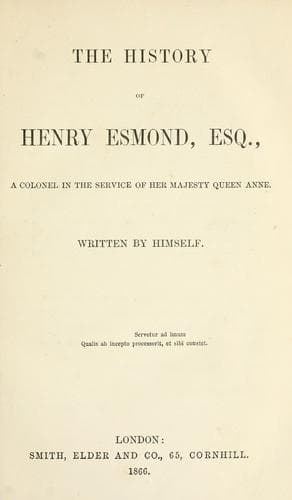
The History of Henry Esmond, Esq., a Colonel in the Service of Her Majesty Queen AnneThackeray, William Makepeace
History
The History of Henry Esmond, Esq., a Colonel in the Service of Her Majesty Queen Anne
Thackeray, William Makepeace
Great Britain -- History -- Anne, 1702-1714 -- Fiction; Historical fiction
After he had been shown to her room by the groom of the chamber, who
filled many offices besides in her ladyship's modest household, and
after a proper interval, his elderly goddess Diana vouchsafed to appear
to the young man. A blackamoor in a Turkish habit, with red boots and a
silver collar, on which the Viscountess's arms were engraven, preceded
her and bore her cushion; then came her gentlewoman; a little pack of
spaniels barking and frisking about preceded the austere huntress--then,
behold, the Viscountess herself “dropping odors.” Esmond recollected
from his childhood that rich aroma of musk which his mother-in-law
(for she may be called so) exhaled. As the sky grows redder and redder
towards sunset, so, in the decline of her years, the cheeks of my Lady
Dowager blushed more deeply. Her face was illuminated with vermilion,
which appeared the brighter from the white paint employed to set it off.
She wore the ringlets which had been in fashion in King Charles's time;
whereas the ladies of King William's had head-dresses like the towers of
Cybele. Her eyes gleamed out from the midst of this queer structure of
paint, dyes, and pomatums. Such was my Lady Viscountess, Mr. Esmond's
father's widow.
He made her such a profound bow as her dignity and relationship merited,
and advanced with the greatest gravity, and once more kissed that
hand, upon the trembling knuckles of which glittered a score of
rings--remembering old times when that trembling hand made him tremble.
“Marchioness,” says he, bowing, and on one knee, “is it only the hand I
may have the honor of saluting?” For, accompanying that inward laughter,
which the sight of such an astonishing old figure might well produce
in the young man, there was good will too, and the kindness of
consanguinity. She had been his father's wife, and was his grandfather's
daughter. She had suffered him in old days, and was kind to him now
after her fashion. And now that bar-sinister was removed from Esmond's
thought, and that secret opprobrium no longer cast upon his mind, he was
pleased to feel family ties and own them--perhaps secretly vain of the
sacrifice he had made, and to think that he, Esmond, was really the
chief of his house, and only prevented by his own magnanimity from
advancing his claim.
At least, ever since he had learned that secret from his poor patron
on his dying bed, actually as he was standing beside it, he had felt an
independency which he had never known before, and which since did not
desert him. So he called his old aunt Marchioness, but with an air as if
he was the Marquis of Esmond who so addressed her.
Public-domain text, read in full here on John Shaqi.
Reviews
Reviews
No reviews yet
Be the first to share your thoughts on this work.
Elsewhere in the archive
Join the Discussion
Join the discussion
Sign in to leave a comment or review.
Sign InorCreate an account