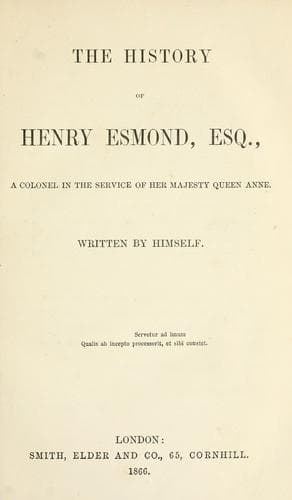
The History of Henry Esmond, Esq., a Colonel in the Service of Her Majesty Queen AnneThackeray, William Makepeace
History
The History of Henry Esmond, Esq., a Colonel in the Service of Her Majesty Queen Anne
Thackeray, William Makepeace
Great Britain -- History -- Anne, 1702-1714 -- Fiction; Historical fiction
Did she read in the young gentleman's eyes, which had now no fear of
hers or their superannuated authority, that he knew or suspected the
truth about his birth? She gave a start of surprise at his altered
manner: indeed, it was quite a different bearing to that of the
Cambridge student who had paid her a visit two years since, and whom
she had dismissed with five pieces sent by the groom of the chamber. She
eyed him, then trembled a little more than was her wont, perhaps, and
said, “Welcome, cousin,” in a frightened voice.
His resolution, as has been said before, had been quite different,
namely, so to bear himself through life as if the secret of his birth
was not known to him; but he suddenly and rightly determined on a
different course. He asked that her ladyship's attendants should be
dismissed, and when they were private--“Welcome, nephew, at least,
madam, it should be,” he said. “A great wrong has been done to me and to
you, and to my poor mother, who is no more.”
“I declare before heaven that I was guiltless of it,” she cried out,
giving up her cause at once. “It was your wicked father who--”
“Who brought this dishonor on our family,” says Mr. Esmond. “I know it
full well. I want to disturb no one. Those who are in present possession
have been my dearest benefactors, and are quite innocent of intentional
wrong to me. The late lord, my dear patron, knew not the truth until a
few months before his death, when Father Holt brought the news to him.”
“The wretch! he had it in confession! he had it in confession!” cried
out the Dowager Lady.
“Not so. He learned it elsewhere as well as in confession,” Mr. Esmond
answered. “My father, when wounded at the Boyne, told the truth to a
French priest, who was in hiding after the battle, as well as to the
priest there, at whose house he died. This gentleman did not think fit
to divulge the story till he met with Mr. Holt at Saint Omer's. And
the latter kept it back for his own purpose, and until he had learned
whether my mother was alive or no. She is dead years since, my poor
patron told me with his dying breath, and I doubt him not. I do not know
even whether I could prove a marriage. I would not if I could. I do
not care to bring shame on our name, or grief upon those whom I love,
however hardly they may use me. My father's son, madam, won't aggravate
the wrong my father did you. Continue to be his widow, and give me
your kindness. 'Tis all I ask from you; and I shall never speak of this
matter again.”
“Mais vous etes un noble jeune homme!” breaks out my lady, speaking, as
usual with her when she was agitated, in the French language.
“Noblesse oblige,” says Mr. Esmond, making her a low bow. “There are
those alive to whom, in return for their love to me, I often fondly said
I would give my life away. Shall I be their enemy now, and quarrel about
a title? What matters who has it? 'Tis with the family still.”
Public-domain text, read in full here on John Shaqi.
Reviews
Reviews
No reviews yet
Be the first to share your thoughts on this work.
Elsewhere in the archive
Join the Discussion
Join the discussion
Sign in to leave a comment or review.
Sign InorCreate an account