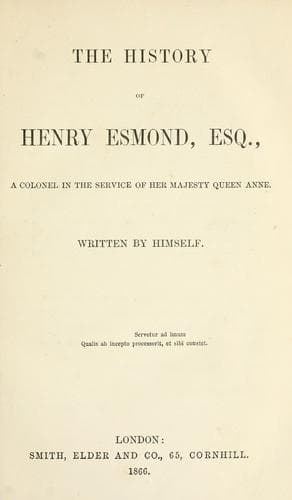
The History of Henry Esmond, Esq., a Colonel in the Service of Her Majesty Queen Anne — John Shaqi
The History of Henry Esmond, Esq., a Colonel in the Service of Her Majesty Queen AnneThackeray, William Makepeace
History
The History of Henry Esmond, Esq., a Colonel in the Service of Her Majesty Queen Anne
Thackeray, William Makepeace
Great Britain -- History -- Anne, 1702-1714 -- Fiction; Historical fiction
On the death of Eustace Esmond at Worcester, Thomas Esmond, nephew to
my Lord Castlewood, and then a stripling, became heir to the title. His
father had taken the Parliament side in the quarrels, and so had been
estranged from the chief of his house; and my Lord Castlewood was at
first so much enraged to think that his title (albeit little more than
an empty one now) should pass to a rascally Roundhead, that he would
have married again, and indeed proposed to do so to a vintner's daughter
at Bruges, to whom his lordship owed a score for lodging when the King
was there, but for fear of the laughter of the Court, and the anger
of his daughter, of whom he stood in awe; for she was in temper as
imperious and violent as my lord, who was much enfeebled by wounds and
drinking, was weak.
Lord Castlewood would have had a match between his daughter Isabel and
her cousin, the son of that Francis Esmond who was killed at Castlewood
siege. And the lady, it was said, took a fancy to the young man, who was
her junior by several years (which circumstance she did not consider to
be a fault in him); but having paid his court, and being admitted to the
intimacy of the house, he suddenly flung up his suit, when it seemed
to be pretty prosperous, without giving a pretext for his behavior.
His friends rallied him at what they laughingly chose to call his
infidelity; Jack Churchill, Frank Esmond's lieutenant in the Royal
Regiment of Foot-guards, getting the company which Esmond vacated, when
he left the Court and went to Tangier in a rage at discovering that his
promotion depended on the complaisance of his elderly affianced bride.
He and Churchill, who had been condiscipuli at St. Paul's School, had
words about this matter; and Frank Esmond said to him with an oath,
“Jack, your sister may be so-and-so, but by Jove my wife shan't!” and
swords were drawn, and blood drawn too, until friends separated them on
this quarrel. Few men were so jealous about the point of honor in those
days; and gentlemen of good birth and lineage thought a royal blot was
an ornament to their family coat. Frank Esmond retired in the sulks,
first to Tangier, whence he returned after two years' service, settling
on a small property he had of his mother, near to Winchester, and became
a country gentleman, and kept a pack of beagles, and never came to
Court again in King Charles's time. But his uncle Castlewood was never
reconciled to him; nor, for some time afterwards, his cousin whom he had
refused.
By places, pensions, bounties from France, and gifts from the King,
whilst his daughter was in favor, Lord Castlewood, who had spent in the
Royal service his youth and fortune, did not retrieve the latter quite,
and never cared to visit Castlewood, or repair it, since the death of
his son, but managed to keep a good house, and figure at Court, and to
save a considerable sum of ready money.
Public-domain text, read in full here on John Shaqi.
Reviews
Reviews
No reviews yet
Be the first to share your thoughts on this work.
Join the Discussion
Join the discussion
Sign in to leave a comment or review.
Sign InorCreate an account