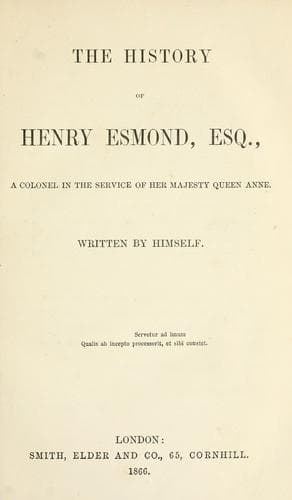
The History of Henry Esmond, Esq., a Colonel in the Service of Her Majesty Queen AnneThackeray, William Makepeace
History
The History of Henry Esmond, Esq., a Colonel in the Service of Her Majesty Queen Anne
Thackeray, William Makepeace
Great Britain -- History -- Anne, 1702-1714 -- Fiction; Historical fiction
country. What he and they called levying war was, in truth, no better
than instigating murder. The noble Prince of Orange burst magnanimously
through those feeble meshes of conspiracy in which his enemies tried
to envelop him: it seemed as if their cowardly daggers broke upon the
breast of his undaunted resolution. After King James's death, the
Queen and her people at St. Germains--priests and women for the most
part--continued their intrigues in behalf of the young Prince, James the
Third, as he was called in France and by his party here (this Prince, or
Chevalier de St. George, was born in the same year with Esmond's young
pupil Frank, my Lord Viscount's son); and the Prince's affairs, being in
the hands of priests and women, were conducted as priests and women will
conduct them, artfully, cruelly, feebly, and to a certain bad issue. The
moral of the Jesuits' story I think as wholesome a one as ever was
writ: the artfullest, the wisest, the most toilsome, and dexterous
plot-builders in the world--there always comes a day when the roused
public indignation kicks their flimsy edifice down, and sends its
cowardly enemies a-flying. Mr. Swift hath finely described that passion
for intrigue, that love of secrecy, slander, and lying, which belongs to
weak people, hangers-on of weak courts. 'Tis the nature of such to
hate and envy the strong, and conspire their ruin; and the conspiracy
succeeds very well, and everything presages the satisfactory overthrow
of the great victim; until one day Gulliver rouses himself, shakes off
the little vermin of an enemy, and walks away unmolested. Ah! the Irish
soldiers might well say after the Boyne, “Change kings with us and we
will fight it over again.” Indeed, the fight was not fair between the
two. 'Twas a weak, priest-ridden, woman-ridden man, with such puny
allies and weapons as his own poor nature led him to choose, contending
against the schemes, the generalship, the wisdom, and the heart of a
hero.
Public-domain text, read in full here on John Shaqi.
Reviews
Reviews
No reviews yet
Be the first to share your thoughts on this work.
Elsewhere in the archive
Join the Discussion
Join the discussion
Sign in to leave a comment or review.
Sign InorCreate an account