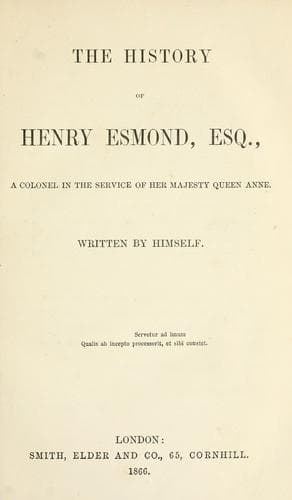
The History of Henry Esmond, Esq., a Colonel in the Service of Her Majesty Queen AnneThackeray, William Makepeace
History
The History of Henry Esmond, Esq., a Colonel in the Service of Her Majesty Queen Anne
Thackeray, William Makepeace
Great Britain -- History -- Anne, 1702-1714 -- Fiction; Historical fiction
On one of these many coward's errands then, (for, as I view them now,
I can call them no less,) Mr. Holt had come to my lord at Castlewood,
proposing some infallible plan for the Prince of Orange's destruction,
in which my Lord Viscount, loyalist as he was, had indignantly refused
to join. As far as Mr. Esmond could gather from his dying words, Holt
came to my lord with a plan of insurrection, and offer of the renewal,
in his person, of that marquis's title which King James had conferred on
the preceding viscount; and on refusal of this bribe, a threat was made,
on Holt's part, to upset my Lord Viscount's claim to his estate and
title of Castlewood altogether. To back this astounding piece of
intelligence, of which Henry Esmond's patron now had the first light,
Holt came armed with the late lord's dying declaration, after the affair
of the Boyne, at Trim, in Ireland, made both to the Irish priest and a
French ecclesiastic of Holt's order, that was with King James's army.
Holt showed, or pretended to show, the marriage certificate of the late
Viscount Esmond with my mother, in the city of Brussels, in the year
1677, when the viscount, then Thomas Esmond, was serving with the
English army in Flanders; he could show, he said, that this Gertrude,
deserted by her husband long since, was alive, and a professed nun in
the year 1685, at Brussels, in which year Thomas Esmond married
his uncle's daughter, Isabella, now called Viscountess Dowager of
Castlewood; and leaving him, for twelve hours, to consider this
astounding news (so the poor dying lord said), disappeared with his
papers in the mysterious way in which he came. Esmond knew how, well
enough: by that window from which he had seen the Father issue:--but
there was no need to explain to my poor lord, only to gather from his
parting lips the words which he would soon be able to utter no more.
Ere the twelve hours were over, Holt himself was a prisoner, implicated
in Sir John Fenwick's conspiracy, and locked up at Hexton first, whence
he was transferred to the Tower; leaving the poor Lord Viscount, who
was not aware of the others being taken, in daily apprehension of his
return, when (as my Lord Castlewood declared, calling God to witness,
and with tears in his dying eyes) it had been his intention at once to
give up his estate and his title to their proper owner, and to retire to
his own house at Walcote with his family. “And would to God I had done
it,” the poor lord said. “I would not be here now, wounded to death, a
miserable, stricken man!”
My lord waited day after day, and, as may be supposed, no messenger
came; but at a month's end Holt got means to convey to him a message
out of the Tower, which was to this effect: that he should consider all
unsaid that had been said, and that things were as they were.
Public-domain text, read in full here on John Shaqi.
Reviews
Reviews
No reviews yet
Be the first to share your thoughts on this work.
Elsewhere in the archive
Join the Discussion
Join the discussion
Sign in to leave a comment or review.
Sign InorCreate an account