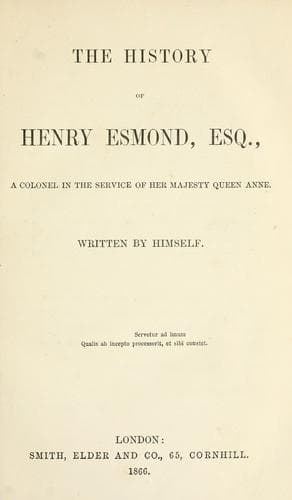
The History of Henry Esmond, Esq., a Colonel in the Service of Her Majesty Queen AnneThackeray, William Makepeace
History
The History of Henry Esmond, Esq., a Colonel in the Service of Her Majesty Queen Anne
Thackeray, William Makepeace
Great Britain -- History -- Anne, 1702-1714 -- Fiction; Historical fiction
Esmond was enabled to present to her ladyship through his aunt's
bounty, and who promised that she would take charge of Esmond's fortune.
He had the honor to make his appearance at the Queen's drawing-room
occasionally, and to frequent my Lord Marlborough's levees. That
great man received the young one with very especial favor, so Esmond's
comrades said, and deigned to say that he had received the best reports
of Mr. Esmond, both for courage and ability, whereon you may be sure
the young gentleman made a profound bow, and expressed himself eager to
serve under the most distinguished captain in the world.
Whilst his business was going on thus prosperously, Esmond had his
share of pleasure too, and made his appearance along with other young
gentlemen at the coffee-houses, the theatres, and the Mall. He longed to
hear of his dear mistress and her family: many a time, in the midst of
the gayeties and pleasures of the town, his heart fondly reverted to
them; and often as the young fellows of his society were making merry
at the tavern, and calling toasts (as the fashion of that day was) over
their wine, Esmond thought of persons--of two fair women, whom he had
been used to adore almost, and emptied his glass with a sigh.
By this time the elder Viscountess had grown tired again of the younger,
and whenever she spoke of my lord's widow, 'twas in terms by no means
complimentary towards that poor lady: the younger woman not needing her
protection any longer, the elder abused her. Most of the family quarrels
that I have seen in life (saving always those arising from money
disputes, when a division of twopence halfpenny will often drive the
dearest relatives into war and estrangement,) spring out of jealousy
and envy. Jack and Tom, born of the same family and to the same fortune,
live very cordially together, not until Jack is ruined when Tom deserts
him, but until Tom makes a sudden rise in prosperity, which Jack can't
forgive. Ten times to one 'tis the unprosperous man that is angry, not
the other who is in fault. 'Tis Mrs. Jack, who can only afford a chair,
that sickens at Mrs. Tom's new coach-and-sick, cries out against her
sister's airs, and sets her husband against his brother. 'Tis Jack who
sees his brother shaking hands with a lord (with whom Jack would like
to exchange snuff-boxes himself), that goes home and tells his wife how
poor Tom is spoiled, he fears, and no better than a sneak, parasite, and
beggar on horse back. I remember how furious the coffee-house wits were
with Dick Steele when he set up his coach and fine house in Bloomsbury:
they began to forgive him when the bailiffs were after him, and abused
Mr. Addison for selling Dick's country-house. And yet Dick in the
sponging-house, or Dick in the Park, with his four mares and plated
harness, was exactly the same gentle, kindly, improvident, jovial Dick
Steele: and yet Mr. Addison was perfectly right in getting the money
which was his, and not giving up the amount of his just claim, to
Public-domain text, read in full here on John Shaqi.
Reviews
Reviews
No reviews yet
Be the first to share your thoughts on this work.
Elsewhere in the archive
Join the Discussion
Join the discussion
Sign in to leave a comment or review.
Sign InorCreate an account