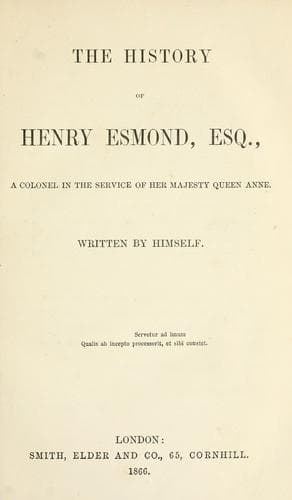
The History of Henry Esmond, Esq., a Colonel in the Service of Her Majesty Queen AnneThackeray, William Makepeace
History
The History of Henry Esmond, Esq., a Colonel in the Service of Her Majesty Queen Anne
Thackeray, William Makepeace
Great Britain -- History -- Anne, 1702-1714 -- Fiction; Historical fiction
be spent by Dick upon champagne and fiddlers, laced clothes, fine
furniture, and parasites, Jew and Christian, male and female, who clung
to him. As, according to the famous maxim of Monsieur de Rochefoucault,
“in our friends' misfortunes there's something secretly pleasant to us;”
so, on the other hand, their good fortune is disagreeable. If 'tis hard
for a man to bear his own good luck, 'tis harder still for his friends
to bear it for him and but few of them ordinarily can stand that trial:
whereas one of the “precious uses” of adversity is, that it is a great
reconciler; that it brings back averted kindness, disarms animosity, and
causes yesterday's enemy to fling his hatred aside, and hold out a hand
to the fallen friend of old days. There's pity and love, as well as
envy, in the same heart and towards the same person. The rivalry stops
when the competitor tumbles; and, as I view it, we should look at these
agreeable and disagreeable qualities of our humanity humbly alike. They
are consequent and natural, and our kindness and meanness both manly.
So you may either read the sentence, that the elder of Esmond's two
kinswomen pardoned the younger her beauty, when that had lost somewhat
of its freshness, perhaps; and forgot most her grievances against the
other, when the subject of them was no longer prosperous and enviable;
or we may say more benevolently (but the sum comes to the same figures,
worked either way,) that Isabella repented of her unkindness towards
Rachel, when Rachel was unhappy; and, bestirring herself in behalf of
the poor widow and her children, gave them shelter and friendship.
The ladies were quite good friends as long as the weaker one needed a
protector. Before Esmond went away on his first campaign, his mistress
was still on terms of friendship (though a poor little chit, a
woman that had evidently no spirit in her, &c.) with the elder Lady
Castlewood; and Mistress Beatrix was allowed to be a beauty.
But between the first year of Queen Anne's reign, and the second, sad
changes for the worse had taken place in the two younger ladies,
at least in the elder's description of them. Rachel, Viscountess
Castlewood, had no more face than a dumpling, and Mrs. Beatrix was grown
quite coarse, and was losing all her beauty. Little Lord Blandford--(she
never would call him Lord Blandford; his father was Lord Churchill--the
King, whom he betrayed, had made him Lord Churchill, and he was Lord
Churchill still)--might be making eyes at her; but his mother, that
vixen of a Sarah Jennings, would never hear of such a folly. Lady
Marlborough had got her to be a maid of honor at Court to the Princess,
but she would repent of it. The widow Francis (she was but Mrs. Francis
Esmond) was a scheming, artful, heartless hussy. She was spoiling her
brat of a boy, and she would end by marrying her chaplain.
“What, Tusher!” cried Mr. Esmond, feeling a strange pang of rage and
astonishment.
Public-domain text, read in full here on John Shaqi.
Reviews
Reviews
No reviews yet
Be the first to share your thoughts on this work.
Elsewhere in the archive
Join the Discussion
Join the discussion
Sign in to leave a comment or review.
Sign InorCreate an account