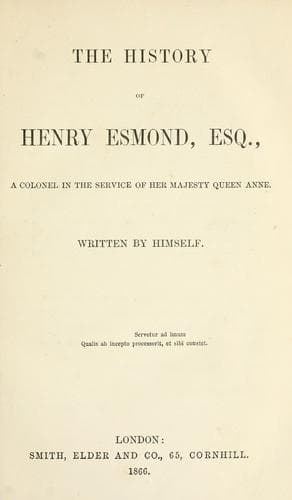
The History of Henry Esmond, Esq., a Colonel in the Service of Her Majesty Queen AnneThackeray, William Makepeace
History
The History of Henry Esmond, Esq., a Colonel in the Service of Her Majesty Queen Anne
Thackeray, William Makepeace
Great Britain -- History -- Anne, 1702-1714 -- Fiction; Historical fiction
And then came a fiercer pang of temptation. “A word from me,” Harry
thought, “a syllable of explanation, and all this might be changed; but
no, I swore it over the dying bed of my benefactor. For the sake of him
and his; for the sacred love and kindness of old days; I gave my promise
to him, and may kind heaven enable me to keep my vow!”
The next day, although Esmond gave no sign of what was going on in his
mind, but strove to be more than ordinarily gay and cheerful when he met
his friends at the morning meal, his dear mistress, whose clear eyes it
seemed no emotion of his could escape, perceived that something troubled
him, for she looked anxiously towards him more than once during the
breakfast, and when he went up to his chamber afterwards she presently
followed him, and knocked at his door.
As she entered, no doubt the whole story was clear to her at once,
for she found our young gentleman packing his valise, pursuant to the
resolution which he had come to over-night of making a brisk retreat out
of this temptation.
She closed the door very carefully behind her, and then leant against
it, very pale, her hands folded before her, looking at the young man,
who was kneeling over his work of packing. “Are you going so soon?” she
said.
He rose up from his knees, blushing, perhaps, to be so discovered, in
the very act, as it were, and took one of her fair little hands--it was
that which had her marriage ring on--and kissed it.
“It is best that it should be so, dearest lady,” he said.
“I knew you were going, at breakfast. I--I thought you might stay. What
has happened? Why can't you remain longer with us? What has Frank told
you--you were talking together late last night?”
“I had but three days' leave from Chelsey,” Esmond said, as gayly as he
could. “My aunt--she lets me call her aunt--is my mistress now! I owe
her my lieutenancy and my laced coat. She has taken me into high favor;
and my new General is to dine at Chelsey to-morrow--General Lumley,
madam--who has appointed me his aide-de-camp, and on whom I must have
the honor of waiting. See, here is a letter from the Dowager; the
post brought it last night; and I would not speak of it, for fear of
disturbing our last merry meeting.”
My lady glanced at the letter, and put it down with a smile that
was somewhat contemptuous. “I have no need to read the letter,” says
she--(indeed, 'twas as well she did not; for the Chelsey missive, in the
poor Dowager's usual French jargon, permitted him a longer holiday
than he said. “Je vous donne,” quoth her ladyship, “oui jour, pour vous
fatigay parfaictement de vos parens fatigans”)--“I have no need to read
the letter,” says she. “What was it Frank told you last night?”
Public-domain text, read in full here on John Shaqi.
Reviews
Reviews
No reviews yet
Be the first to share your thoughts on this work.
Elsewhere in the archive
Join the Discussion
Join the discussion
Sign in to leave a comment or review.
Sign InorCreate an account