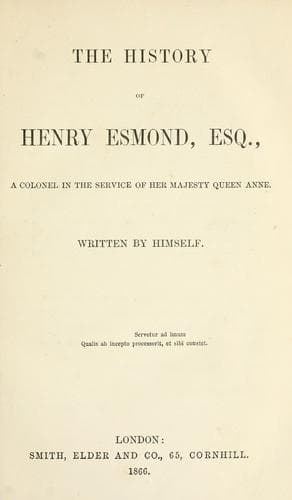
The History of Henry Esmond, Esq., a Colonel in the Service of Her Majesty Queen AnneThackeray, William Makepeace
History
The History of Henry Esmond, Esq., a Colonel in the Service of Her Majesty Queen Anne
Thackeray, William Makepeace
Great Britain -- History -- Anne, 1702-1714 -- Fiction; Historical fiction
His qualities were pretty well known in the army, where there were
parties of all politics, and of plenty of shrewdness and wit; but there
existed such a perfect confidence in him, as the first captain of the
world, and such a faith and admiration in his prodigious genius and
fortune, that the very men whom he notoriously cheated of their pay, the
chiefs whom he used and injured--(for he used all men, great and small,
that came near him, as his instruments alike, and took something of
theirs, either some quality or some property)--the blood of a soldier, it
might be, or a jewelled hat, or a hundred thousand crowns from a king,
or a portion out of a starving sentinel's three-farthings; or (when he
was young) a kiss from a woman, and the gold chain off her neck, taking
all he could from woman or man, and having, as I have said, this of the
godlike in him, that he could see a hero perish or a sparrow fall, with
the same amount of sympathy for either. Not that he had no tears; he
could always order up this reserve at the proper moment to battle; he
could draw upon tears or smiles alike, and whenever need was for using
this cheap coin. He would cringe to a shoeblack, as he would flatter a
minister or a monarch; be haughty, be humble, threaten, repent, weep,
grasp your hand, (or stab you whenever he saw occasion)--but yet those
of the army, who knew him best and had suffered most from him, admired
him most of all: and as he rode along the lines to battle or galloped
up in the nick of time to a battalion reeling from before the enemy's
charge or shot, the fainting men and officers got new courage as they
saw the splendid calm of his face, and felt that his will made them
irresistible.
After the great victory of Blenheim the enthusiasm of the army for the
Duke, even of his bitterest personal enemies in it, amounted to a sort
of rage--nay, the very officers who cursed him in their hearts were
among the most frantic to cheer him. Who could refuse his meed of
admiration to such a victory and such a victor? Not he who writes: a man
may profess to be ever so much a philosopher; but he who fought on that
day must feel a thrill of pride as he recalls it.
The French right was posted near to the village of Blenheim, on the
Danube, where the Marshal Tallard's quarters were; their line extending
through, it may be a league and a half, before Lutzingen and up to a
woody hill, round the base of which, and acting against the Prince of
Savoy, were forty of his squadrons.
Here was a village that the Frenchmen had burned, the wood being, in
fact, a better shelter and easier of guard than any village.
Public-domain text, read in full here on John Shaqi.
Reviews
Reviews
No reviews yet
Be the first to share your thoughts on this work.
Elsewhere in the archive
Join the Discussion
Join the discussion
Sign in to leave a comment or review.
Sign InorCreate an account