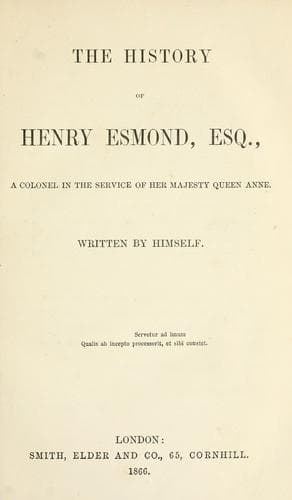
The History of Henry Esmond, Esq., a Colonel in the Service of Her Majesty Queen AnneThackeray, William Makepeace
History
The History of Henry Esmond, Esq., a Colonel in the Service of Her Majesty Queen Anne
Thackeray, William Makepeace
Great Britain -- History -- Anne, 1702-1714 -- Fiction; Historical fiction
Before these two villages and the French lines ran a little stream, not
more than two foot broad, through a marsh (that was mostly dried up
from the heats of the weather), and this stream was the only separation
between the two armies--ours coming up and ranging themselves in line
of battle before the French, at six o'clock in the morning; so that our
line was quite visible to theirs; and the whole of this great plain was
black and swarming with troops for hours before the cannonading began.
On one side and the other this cannonading lasted many hours. The French
guns being in position in front of their line, and doing severe damage
among our horse especially, and on our right wing of Imperialists under
the Prince of Savoy, who could neither advance his artillery nor his
lines, the ground before him being cut up by ditches, morasses, and very
difficult of passage for the guns.
It was past mid-day when the attack began on our left, where Lord Cutts
commanded, the bravest and most beloved officer in the English army.
And now, as if to make his experience in war complete, our young
aide-de-camp having seen two great armies facing each other in line of
battle, and had the honor of riding with orders from one end to other
of the line, came in for a not uncommon accompaniment of military glory,
and was knocked on the head, along with many hundred of brave fellows,
almost at the very commencement of this famous day of Blenheim. A little
after noon, the disposition for attack being completed with much delay
and difficulty, and under a severe fire from the enemy's guns, that
were better posted and more numerous than ours, a body of English and
Hessians, with Major-General Wilkes commanding at the extreme left of
our line, marched upon Blenheim, advancing with great gallantry, the
Major-General on foot, with his officers, at the head of the column, and
marching, with his hat off, intrepidly in the face of the enemy, who was
pouring in a tremendous fire from his guns and musketry, to which our
people were instructed not to reply, except with pike and bayonet when
they reached the French palisades. To these Wilkes walked intrepidly,
and struck the woodwork with his sword before our people charged it.
He was shot down at the instant, with his colonel, major, and several
officers; and our troops cheering and huzzaing, and coming on, as they
did, with immense resolution and gallantry, were nevertheless stopped by
the murderous fire from behind the enemy's defences, and then attacked
in flank by a furious charge of French horse which swept out of
Blenheim, and cut down our men in great numbers. Three fierce and
desperate assaults of our foot were made and repulsed by the enemy; so
that our columns of foot were quite shattered, and fell back, scrambling
over the little rivulet, which we had crossed so resolutely an hour
before, and pursued by the French cavalry, slaughtering us and cutting
us down.
Public-domain text, read in full here on John Shaqi.
Reviews
Reviews
No reviews yet
Be the first to share your thoughts on this work.
Elsewhere in the archive
Join the Discussion
Join the discussion
Sign in to leave a comment or review.
Sign InorCreate an account