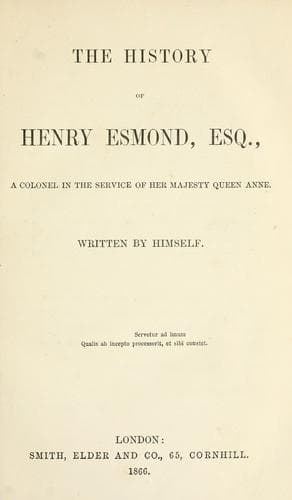
The History of Henry Esmond, Esq., a Colonel in the Service of Her Majesty Queen AnneThackeray, William Makepeace
History
The History of Henry Esmond, Esq., a Colonel in the Service of Her Majesty Queen Anne
Thackeray, William Makepeace
Great Britain -- History -- Anne, 1702-1714 -- Fiction; Historical fiction
No matter what the verses were, and, to say truth, Mr. Esmond found some
of them more than indifferent, Dick's enthusiasm for his chief
never faltered, and in every line from Addison's pen, Steele found
a master-stroke. By the time Dick had come to that part of the poem,
wherein the bard describes as blandly as though he were recording
a dance at the opera, or a harmless bout of bucolic cudgelling at a
village fair, that bloody and ruthless part of our campaign, with the
remembrance whereof every soldier who bore a part in it must sicken
with shame--when we were ordered to ravage and lay waste the Elector's
country; and with fire and murder, slaughter and crime, a great part of
his dominions was overrun; when Dick came to the lines--
“In vengeance roused the soldier fills his hand
With sword and fire, and ravages the land,
In crackling flames a thousand harvests burn,
A thousand villages to ashes turn.
To the thick woods the woolly flocks retreat,
And mixed with bellowing herds confusedly bleat.
Their trembling lords the common shade partake,
And cries of infants found in every brake.
The listening soldier fixed in sorrow stands,
Loth to obey his leader's just commands.
The leader grieves, by generous pity swayed,
To see his just commands so well obeyed;”
by this time wine and friendship had brought poor Dick to a perfectly
maudlin state, and he hiccupped out the last line with a tenderness that
set one of his auditors a-laughing.
“I admire the license of your poets,” says Esmond to Mr. Addison. (Dick,
after reading of the verses, was fain to go off, insisting on kissing
his two dear friends before his departure, and reeling away with his
periwig over his eyes.) “I admire your art: the murder of the campaign
is done to military music, like a battle at the opera, and the virgins
shriek in harmony, as our victorious grenadiers march into their
villages. Do you know what a scene it was?”--(by this time, perhaps,
the wine had warmed Mr. Esmond's head too,)--“what a triumph you are
celebrating? what scenes of shame and horror were enacted, over which
the commander's genius presided, as calm as though he didn't belong to
our sphere? You talk of the 'listening soldier fixed in sorrow,' the
'leader's grief swayed by generous pity;' to my belief the leader cared
no more for bleating flocks than he did for infants' cries, and many
of our ruffians butchered one or the other with equal alacrity. I was
ashamed of my trade when I saw those horrors perpetrated, which came
under every man's eyes. You hew out of your polished verses a stately
image of smiling victory; I tell you 'tis an uncouth, distorted, savage
idol; hideous, bloody, and barbarous. The rites performed before it are
shocking to think of. You great poets should show it as it is--ugly and
horrible, not beautiful and serene. Oh, sir, had you made the campaign,
believe me, you never would have sung it so.”
Public-domain text, read in full here on John Shaqi.
Reviews
Reviews
No reviews yet
Be the first to share your thoughts on this work.
Elsewhere in the archive
Join the Discussion
Join the discussion
Sign in to leave a comment or review.
Sign InorCreate an account