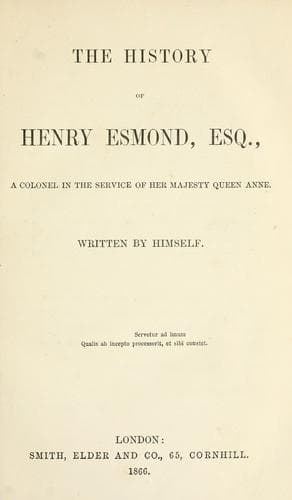
The History of Henry Esmond, Esq., a Colonel in the Service of Her Majesty Queen AnneThackeray, William Makepeace
History
The History of Henry Esmond, Esq., a Colonel in the Service of Her Majesty Queen Anne
Thackeray, William Makepeace
Great Britain -- History -- Anne, 1702-1714 -- Fiction; Historical fiction
During this little outbreak, Mr. Addison was listening, smoking out of
his long pipe, and smiling very placidly. “What would you have?” says
he. “In our polished days, and according to the rules of art, 'tis
impossible that the Muse should depict tortures or begrime her hands
with the horrors of war. These are indicated rather than described; as
in the Greek tragedies, that, I dare say, you have read (and sure there
can be no more elegant specimens of composition), Agamemnon is slain, or
Medea's children destroyed, away from the scene;--the chorus occupying
the stage and singing of the action to pathetic music. Something of this
I attempt, my dear sir, in my humble way: 'tis a panegyric I mean to
write, and not a satire. Were I to sing as you would have me, the town
would tear the poet in pieces, and burn his book by the hands of the
common hangman. Do you not use tobacco? Of all the weeds grown on earth,
sure the nicotian is the most soothing and salutary. We must paint our
great Duke,” Mr. Addison went on, “not as a man, which no doubt he is,
with weaknesses like the rest of us, but as a hero. 'Tis in a triumph,
not a battle, that your humble servant is riding his sleek Pegasus. We
college poets trot, you know, on very easy nags; it hath been, time
out of mind, part of the poet's profession to celebrate the actions of
heroes in verse, and to sing the deeds which you men of war perform. I
must follow the rules of my art, and the composition of such a strain
as this must be harmonious and majestic, not familiar, or too near
the vulgar truth. Si parva licet: if Virgil could invoke the divine
Augustus, a humbler poet from the banks of the Isis may celebrate a
victory and a conqueror of our own nation, in whose triumphs every
Briton has a share, and whose glory and genius contributes to every
citizen's individual honor. When hath there been, since our Henrys' and
Edwards' days, such a great feat of arms as that from which you yourself
have brought away marks of distinction? If 'tis in my power to sing that
song worthily, I will do so, and be thankful to my Muse. If I fail as a
poet, as a Briton at least I will show my loyalty, and fling up my cap
and huzzah for the conqueror:--
“'Rheni pacator et Istri
Omnis in hoc uno variis discordia cessit
Ordinibus; laetatur eques, plauditque senator,
Votaque patricio certant plebeia favori.'”
“There were as brave men on that field,” says Mr. Esmond (who never
could be made to love the Duke of Marlborough, nor to forget those
stories which he used to hear in his youth regarding that great chiefs
selfishness and treachery)--“there were men at Blenheim as good as the
leader, whom neither knights nor senators applauded, nor voices plebeian
or patrician favored, and who lie there forgotten, under the clods. What
poet is there to sing them?”
Public-domain text, read in full here on John Shaqi.
Reviews
Reviews
No reviews yet
Be the first to share your thoughts on this work.
Elsewhere in the archive
Join the Discussion
Join the discussion
Sign in to leave a comment or review.
Sign InorCreate an account