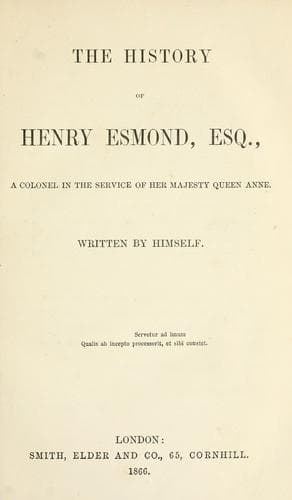
The History of Henry Esmond, Esq., a Colonel in the Service of Her Majesty Queen AnneThackeray, William Makepeace
History
The History of Henry Esmond, Esq., a Colonel in the Service of Her Majesty Queen Anne
Thackeray, William Makepeace
Great Britain -- History -- Anne, 1702-1714 -- Fiction; Historical fiction
Within a month after this day, Mr. Addison's ticket had come up a
prodigious prize in the lottery of life. All the town was in an uproar
of admiration of his poem, the “Campaign,” which Dick Steele was
spouting at every coffee-house in Whitehall and Covent Garden. The wits
on the other side of Temple Bar saluted him at once as the greatest poet
the world had seen for ages; the people huzza'ed for Marlborough and
for Addison, and, more than this, the party in power provided for the
meritorious poet, and Addison got the appointment of Commissioner of
Excise, which the famous Mr. Locke vacated, and rose from this place to
other dignities and honors; his prosperity from henceforth to the end of
his life being scarce ever interrupted. But I doubt whether he was not
happier in his garret in the Haymarket, than ever he was in his splendid
palace at Kensington; and I believe the fortune that came to him in the
shape of the countess his wife was no better than a shrew and a vixen.
Gay as the town was, 'twas but a dreary place for Mr. Esmond, whether
his charmer was in or out of it, and he was glad when his general gave
him notice that he was going back to his division of the army which lay
in winter-quarters at Bois-le-Duc. His dear mistress bade him
farewell with a cheerful face; her blessing he knew he had always, and
wheresoever fate carried him. Mistress Beatrix was away in attendance on
her Majesty at Hampton Court, and kissed her fair fingertips to him, by
way of adieu, when he rode thither to take his leave. She received her
kinsman in a waiting-room, where there were half a dozen more ladies of
the Court, so that his high-flown speeches, had he intended to make
any (and very likely he did), were impossible; and she announced to her
friends that her cousin was going to the army, in as easy a manner as
she would have said he was going to a chocolate-house. He asked with
a rather rueful face, if she had any orders for the army? and she was
pleased to say that she would like a mantle of Mechlin lace. She made
him a saucy curtsy in reply to his own dismal bow. She deigned to kiss
her fingertips from the window, where she stood laughing with the other
ladies, and chanced to see him as he made his way to the “Toy.” The
Dowager at Chelsey was not sorry to part with him this time. “Mon cher,
vous etes triste comme un sermon,” she did him the honor to say to him;
indeed, gentlemen in his condition are by no means amusing companions,
and besides, the fickle old woman had now found a much more amiable
favorite, and raffoled for her darling lieutenant of the Guard. Frank
remained behind for a while, and did not join the army till later, in
the suite of his Grace the Commander-in-Chief. His dear mother, on the
last day before Esmond went away, and when the three dined together,
made Esmond promise to befriend her boy, and besought Frank to take the
example of his kinsman as of a loyal gentleman and brave soldier, so
Public-domain text, read in full here on John Shaqi.
Reviews
Reviews
No reviews yet
Be the first to share your thoughts on this work.
Elsewhere in the archive
Join the Discussion
Join the discussion
Sign in to leave a comment or review.
Sign InorCreate an account