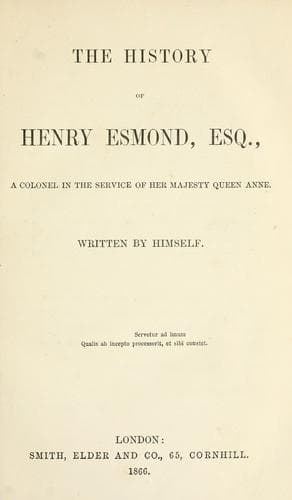
The History of Henry Esmond, Esq., a Colonel in the Service of Her Majesty Queen AnneThackeray, William Makepeace
History
The History of Henry Esmond, Esq., a Colonel in the Service of Her Majesty Queen Anne
Thackeray, William Makepeace
Great Britain -- History -- Anne, 1702-1714 -- Fiction; Historical fiction
“I won it,” cried the other, “with my sword and my spear. There was a
mousquetaire that had it round his neck--such a big mousquetaire, as big
as General Webb. I called out to him to surrender, and that I'd give him
quarter: he called me a petit polisson and fired his pistol at me, and
then sent it at my head with a curse. I rode at him, sir, drove my sword
right under his arm-hole, and broke it in the rascal's body. I found
a purse in his holster with sixty-five Louis in it, and a bundle of
love-letters, and a flask of Hungary-water. Vive la guerre! there are
the ten pieces you lent me. I should like to have a fight every day;”
and he pulled at his little moustache and bade a servant bring a supper
to Captain Esmond.
Harry fell to with a very good appetite; he had tasted nothing since
twenty hours ago, at early dawn. Master Grandson, who read this, do you
look for the history of battles and sieges? Go, find them in the proper
books; this is only the story of your grandfather and his family. Far
more pleasant to him than the victory, though for that too he may say
meminisse juvat, it was to find that the day was over, and his dear
young Castlewood was unhurt.
And would you, sirrah, wish to know how it was that a sedate Captain
of Foot, a studious and rather solitary bachelor of eight or nine and
twenty years of age, who did not care very much for the jollities which
his comrades engaged in, and was never known to lose his heart in any
garrison-town--should you wish to know why such a man had so prodigious
a tenderness, and tended so fondly a boy of eighteen, wait, my good
friend, until thou art in love with thy schoolfellow's sister, and then
see how mighty tender thou wilt be towards him. Esmond's general and
his Grace the Prince-Duke were notoriously at variance, and the former's
friendship was in nowise likely to advance any man's promotion of whose
services Webb spoke well; but rather likely to injure him, so the army
said, in the favor of the greater man. However, Mr. Esmond had the good
fortune to be mentioned very advantageously by Major-General Webb in his
report after the action; and the major of his regiment and two of the
captains having been killed upon the day of Ramillies, Esmond, who was
second of the lieutenants, got his company, and had the honor of serving
as Captain Esmond in the next campaign.
Public-domain text, read in full here on John Shaqi.
Reviews
Reviews
No reviews yet
Be the first to share your thoughts on this work.
Elsewhere in the archive
Join the Discussion
Join the discussion
Sign in to leave a comment or review.
Sign InorCreate an account