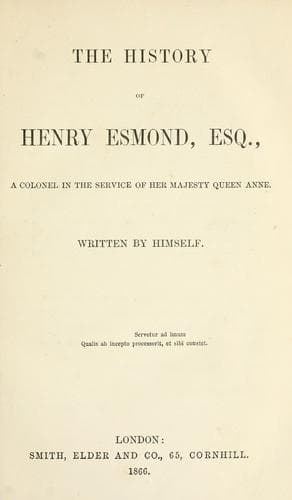
The History of Henry Esmond, Esq., a Colonel in the Service of Her Majesty Queen AnneThackeray, William Makepeace
History
The History of Henry Esmond, Esq., a Colonel in the Service of Her Majesty Queen Anne
Thackeray, William Makepeace
Great Britain -- History -- Anne, 1702-1714 -- Fiction; Historical fiction
My lord went home in the winter, but Esmond was afraid to follow him.
His dear mistress wrote him letters more than once, thanking him, as
mothers know how to thank, for his care and protection of her boy,
extolling Esmond's own merits with a great deal more praise than they
deserved; for he did his duty no better than any other officer; and
speaking sometimes, though gently and cautiously, of Beatrix. News came
from home of at least half a dozen grand matches that the beautiful maid
of honor was about to make. She was engaged to an earl, our gentleman of
St. James's said, and then jilted him for a duke, who, in his turn, had
drawn off. Earl or duke it might be who should win this Helen, Esmond
knew she would never bestow herself on a poor captain. Her conduct, it
was clear, was little satisfactory to her mother, who scarcely mentioned
her, or else the kind lady thought it was best to say nothing, and leave
time to work out its cure. At any rate, Harry was best away from the
fatal object which always wrought him so much mischief; and so he never
asked for leave to go home, but remained with his regiment that was
garrisoned in Brussels, which city fell into our hands when the victory
of Ramillies drove the French out of Flanders.
CHAPTER XIII.
I MEET AN OLD ACQUAINTANCE IN FLANDERS, AND FIND MY MOTHER'S GRAVE AND
MY OWN CRADLE THERE.
Being one day in the Church of St. Gudule, at Brussels, admiring the
antique splendor of the architecture (and always entertaining a great
tenderness and reverence for the Mother Church, that hath been as
wickedly persecuted in England as ever she herself persecuted in the
days of her prosperity), Esmond saw kneeling at a side altar an officer
in a green uniform coat, very deeply engaged in devotion. Something
familiar in the figure and posture of the kneeling man struck Captain
Esmond, even before he saw the officer's face. As he rose up, putting
away into his pocket a little black breviary, such as priests use,
Esmond beheld a countenance so like that of his friend and tutor of
early days, Father Holt, that he broke out into an exclamation of
astonishment and advanced a step towards the gentleman, who was making
his way out of church. The German officer too looked surprised when he
saw Esmond, and his face from being pale grew suddenly red. By this mark
of recognition, the Englishman knew that he could not be mistaken; and
though the other did not stop, but on the contrary rather hastily walked
away towards the door, Esmond pursued him and faced him once more, as
the officer, helping himself to holy water, turned mechanically towards
the altar, to bow to it ere he quitted the sacred edifice.
“My Father!” says Esmond in English.
“Silence! I do not understand. I do not speak English,” says the other
in Latin.
Public-domain text, read in full here on John Shaqi.
Reviews
Reviews
No reviews yet
Be the first to share your thoughts on this work.
Elsewhere in the archive
Join the Discussion
Join the discussion
Sign in to leave a comment or review.
Sign InorCreate an account