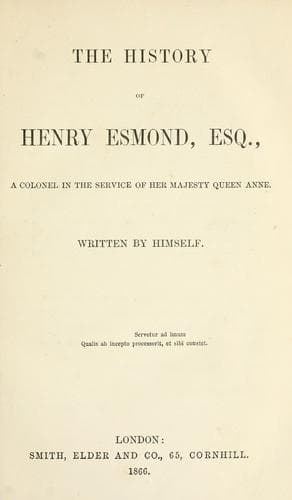
The History of Henry Esmond, Esq., a Colonel in the Service of Her Majesty Queen AnneThackeray, William Makepeace
History
The History of Henry Esmond, Esq., a Colonel in the Service of Her Majesty Queen Anne
Thackeray, William Makepeace
Great Britain -- History -- Anne, 1702-1714 -- Fiction; Historical fiction
Berwick, De la Mothe's chief, was in constant correspondence with his
uncle, the English Generalissimo: I believe on my conscience that 'twas
my Lord Marlborough's intention to prevent those supplies, of which the
Prince of Savoy stood in absolute need, from ever reaching his Highness;
that he meant to sacrifice the little army which covered this convoy,
and to betray it as he had betrayed Tollemache at Brest; as he had
betrayed every friend he had, to further his own schemes of avarice or
ambition. But for the miraculous victory which Esmond's general won over
an army six or seven times greater than his own, the siege of Lille
must have been raised; and it must be remembered that our gallant little
force was under the command of a general whom Marlborough hated, that he
was furious with the conqueror, and tried by the most open and shameless
injustice afterwards to rob him of the credit of his victory.
CHAPTER XV.
GENERAL WEBB WINS THE BATTLE OF WYNENDAEL.
By the besiegers and besieged of Lille, some of the most brilliant feats
of valor were performed that ever illustrated any war. On the French
side (whose gallantry was prodigious, the skill and bravery of Marshal
Boufflers actually eclipsing those of his conqueror, the Prince of
Savoy) may be mentioned that daring action of Messieurs de Luxembourg
and Tournefort, who, with a body of horse and dragoons, carried powder
into the town, of which the besieged were in extreme want, each soldier
bringing a bag with forty pounds of powder behind him; with which
perilous provision they engaged our own horse, faced the fire of the
foot brought out to meet them: and though half of the men were blown up
in the dreadful errand they rode on, a part of them got into the town
with the succors of which the garrison was so much in want. A French
officer, Monsieur du Bois, performed an act equally daring, and
perfectly successful. The Duke's great army lying at Helchin, and
covering the siege, and it being necessary for M. de Vendosme to get
news of the condition of the place, Captain Dubois performed his famous
exploit: not only passing through the lines of the siege, but swimming
afterwards no less than seven moats and ditches: and coming back the
same way, swimming with his letters in his mouth.
By these letters Monsieur de Boufflers said that he could undertake
to hold the place till October; and that if one of the convoys of the
Allies could be intercepted, they must raise the siege altogether.
Such a convoy as hath been said was now prepared at Ostend, and about to
march for the siege; and on the 27th September we (and the French
too) had news that it was on its way. It was composed of 700 wagons,
containing ammunition of all sorts, and was escorted out of Ostend by
2,000 infantry and 300 horse. At the same time M. de la Mothe quitted
Bruges, having with him five-and-thirty battalions, and upwards of sixty
squadrons and forty guns, in pursuit of the convoy.
Public-domain text, read in full here on John Shaqi.
Reviews
Reviews
No reviews yet
Be the first to share your thoughts on this work.
Elsewhere in the archive
Join the Discussion
Join the discussion
Sign in to leave a comment or review.
Sign InorCreate an account