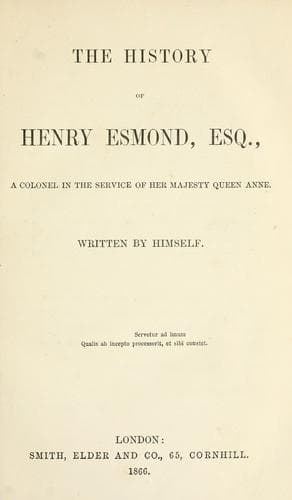
The History of Henry Esmond, Esq., a Colonel in the Service of Her Majesty Queen AnneThackeray, William Makepeace
History
The History of Henry Esmond, Esq., a Colonel in the Service of Her Majesty Queen Anne
Thackeray, William Makepeace
Great Britain -- History -- Anne, 1702-1714 -- Fiction; Historical fiction
Major-General Webb had meanwhile made up a force of twenty battalions
and three squadrons of dragoons at Turout, whence he moved to cover the
convoy and pursue La Mothe: with whose advanced guard ours came up upon
the great plain of Turout, and before the little wood and castle of
Wynendael; behind which the convoy was marching.
As soon as they came in sight of the enemy, our advanced troops were
halted, with the wood behind them, and the rest of our force brought up
as quickly as possible, our little body of horse being brought forward
to the opening of the plain, as our General said, to amuse the enemy.
When M. de la Mothe came up, he found us posted in two lines in front of
the wood; and formed his own army in battle facing ours, in eight lines,
four of infantry in front, and dragoons and cavalry behind.
The French began the action, as usual, with a cannonade which lasted
three hours, when they made their attack, advancing in eight lines, four
of foot and four of horse, upon the allied troops in the wood where we
were posted. Their infantry behaved ill; they were ordered to charge
with the bayonet, but, instead, began to fire, and almost at the very
first discharge from our men, broke and fled. The cavalry behaved
better; with these alone, who were three or four times as numerous as
our whole force, Monsieur de la Mothe might have won victory: but only
two of our battalions were shaken in the least; and these speedily
rallied: nor could the repeated attacks of the French horse cause our
troops to budge an inch from the position in the wood in which our
General had placed them.
After attacking for two hours, the French retired at nightfall entirely
foiled. With all the loss we had inflicted upon him, the enemy was still
three times stronger than we: and it could not be supposed that our
General could pursue M. de la Mothe, or do much more than hold our
ground about the wood, from which the Frenchman had in vain attempted
to dislodge us. La Mothe retired behind his forty guns, his cavalry
protecting them better than it had been enabled to annoy us; and
meanwhile the convoy, which was of more importance than all our little
force, and the safe passage of which we would have dropped to the last
man to accomplish, marched away in perfect safety during the action, and
joyfully reached the besieging camp before Lille.
Public-domain text, read in full here on John Shaqi.
Reviews
Reviews
No reviews yet
Be the first to share your thoughts on this work.
Elsewhere in the archive
Join the Discussion
Join the discussion
Sign in to leave a comment or review.
Sign InorCreate an account