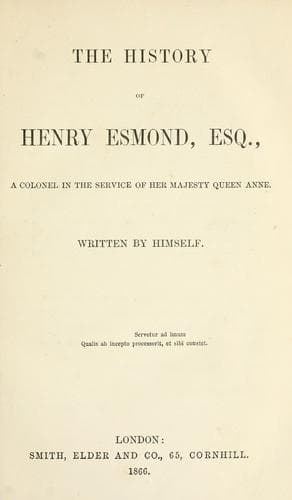
The History of Henry Esmond, Esq., a Colonel in the Service of Her Majesty Queen AnneThackeray, William Makepeace
History
The History of Henry Esmond, Esq., a Colonel in the Service of Her Majesty Queen Anne
Thackeray, William Makepeace
Great Britain -- History -- Anne, 1702-1714 -- Fiction; Historical fiction
As for her ladyship at Chelsey, Esmond's newly adopted mother, she was
now of an age when the danger of any second party doth not disturb the
rest much. She cared for trumps more than for most things in life. She
was firm enough in her own faith, but no longer very bitter against
ours. She had a very good-natured, easy French director, Monsieur
Gauthier by name, who was a gentleman of the world, and would take a
hand of cards with Dean Atterbury, my lady's neighbor at Chelsey, and
was well with all the High Church party. No doubt Monsieur Gauthier knew
what Esmond's peculiar position was, for he corresponded with Holt, and
always treated Colonel Esmond with particular respect and kindness; but
for good reasons the Colonel and the Abbe never spoke on this matter
together, and so they remained perfect good friends.
All the frequenters of my Lady of Chelsey's house were of the Tory and
High Church party. Madame Beatrix was as frantic about the King as her
elderly kinswoman: she wore his picture on her heart; she had a piece
of his hair; she vowed he was the most injured, and gallant, and
accomplished, and unfortunate, and beautiful of princes. Steele, who
quarrelled with very many of his Tory friends, but never with Esmond,
used to tell the Colonel that his kinswoman's house was a rendezvous of
Tory intrigues; that Gauthier was a spy; that Atterbury was a spy;
that letters were constantly going from that house to the Queen at St.
Germains; on which Esmond, laughing, would reply, that they used to
say in the army the Duke of Marlborough was a spy too, and as much in
correspondence with that family as any Jesuit. And without entering very
eagerly into the controversy, Esmond had frankly taken the side of his
family. It seemed to him that King James the Third was undoubtedly King
of England by right: and at his sister's death it would be better to
have him than a foreigner over us. No man admired King William more; a
hero and a conqueror, the bravest, justest, wisest of men--but 'twas by
the sword he conquered the country, and held and governed it by the very
same right that the great Cromwell held it, who was truly and greatly
a sovereign. But that a foreign despotic Prince, out of Germany,
who happened to be descended from King James the First, should
take possession of this empire, seemed to Mr. Esmond a monstrous
injustice--at least, every Englishman had a right to protest, and the
English Prince, the heir-at-law, the first of all. What man of spirit
with such a cause would not back it? What man of honor with such a crown
to win would not fight for it? But that race was destined. That Prince
had himself against him, an enemy he could not overcome. He never dared
to draw his sword, though he had it. He let his chances slip by as he
lay in the lap of opera-girls, or snivelled at the knees of priests
asking pardon; and the blood of heroes, and the devotedness of honest
hearts, and endurance, courage, fidelity, were all spent for him in
vain.
Public-domain text, read in full here on John Shaqi.
Reviews
Reviews
No reviews yet
Be the first to share your thoughts on this work.
Elsewhere in the archive
Join the Discussion
Join the discussion
Sign in to leave a comment or review.
Sign InorCreate an account