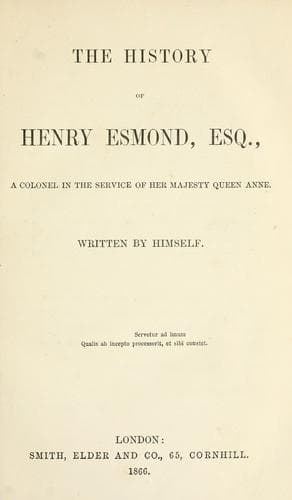
The History of Henry Esmond, Esq., a Colonel in the Service of Her Majesty Queen AnneThackeray, William Makepeace
History
The History of Henry Esmond, Esq., a Colonel in the Service of Her Majesty Queen Anne
Thackeray, William Makepeace
Great Britain -- History -- Anne, 1702-1714 -- Fiction; Historical fiction
But let us return to my Lady of Chelsey, who, when her son Esmond
announced to her ladyship that he proposed to make the ensuing campaign,
took leave of him with perfect alacrity, and was down to piquet with
her gentlewoman before he had well quitted the room on his last visit.
“Tierce to a king,” were the last words he ever heard her say: the
game of life was pretty nearly over for the good lady, and three months
afterwards she took to her bed, where she flickered out without any
pain, so the Abbe Gauthier wrote over to Mr. Esmond, then with his
General on the frontier of France. The Lady Castlewood was with her at
her ending, and had written too, but these letters must have been taken
by a privateer in the packet that brought them; for Esmond knew nothing
of their contents until his return to England.
My Lady Castlewood had left everything to Colonel Esmond, “as a
reparation for the wrong done to him;” 'twas writ in her will. But
her fortune was not much, for it never had been large, and the honest
viscountess had wisely sunk most of the money she had upon an annuity
which terminated with her life. However, there was the house and
furniture, plate and pictures at Chelsey, and a sum of money lying at
her merchant's, Sir Josiah Child, which altogether would realize a
sum of near three hundred pounds per annum, so that Mr. Esmond found
himself, if not rich, at least easy for life. Likewise there were the
famous diamonds which had been said to be worth fabulous sums, though
the goldsmith pronounced they would fetch no more than four thousand
pounds. These diamonds, however, Colonel Esmond reserved, having a
special use for them: but the Chelsey house, plate, goods, &c., with the
exception of a few articles which he kept back, were sold by his orders;
and the sums resulting from the sale invested in the public securities
so as to realize the aforesaid annual income of three hundred pounds.
Having now something to leave, he made a will and despatched it home.
The army was now in presence of the enemy; and a great battle expected
every day. 'Twas known that the General-in-Chief was in disgrace, and
the parties at home strong against him, and there was no stroke this
great and resolute player would not venture to recall his fortune when
it seemed desperate. Frank Castlewood was with Colonel Esmond; his
General having gladly taken the young nobleman on to his staff. His
studies of fortifications at Bruxelles were over by this time. The
fort he was besieging had yielded, I believe, and my lord had not only
marched in with flying colors, but marched out again. He used to tell
his boyish wickednesses with admirable humor, and was the most charming
young scapegrace in the army.
Public-domain text, read in full here on John Shaqi.
Reviews
Reviews
No reviews yet
Be the first to share your thoughts on this work.
Elsewhere in the archive
Join the Discussion
Join the discussion
Sign in to leave a comment or review.
Sign InorCreate an account