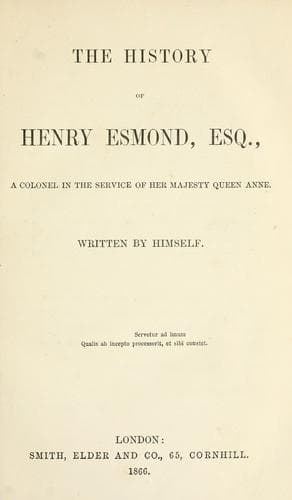
The History of Henry Esmond, Esq., a Colonel in the Service of Her Majesty Queen AnneThackeray, William Makepeace
History
The History of Henry Esmond, Esq., a Colonel in the Service of Her Majesty Queen Anne
Thackeray, William Makepeace
Great Britain -- History -- Anne, 1702-1714 -- Fiction; Historical fiction
It stood on a rising green hill, with woods behind it, in which were
rooks' nests, where the birds at morning and returning home at evening
made a great cawing. At the foot of the hill was a river, with a steep
ancient bridge crossing it; and beyond that a large pleasant green flat,
where the village of Castlewood stood, and stands, with the church in
the midst, the parsonage hard by it, the inn with the blacksmith's forge
beside it, and the sign of the “Three Castles” on the elm. The London
road stretched away towards the rising sun, and to the west were
swelling hills and peaks, behind which many a time Harry Esmond saw the
same sun setting, that he now looks on thousands of miles away across
the great ocean--in a new Castlewood, by another stream, that bears,
like the new country of wandering AEneas, the fond names of the land of
his youth.
The Hall of Castlewood was built with two courts, whereof one only, the
fountain-court, was now inhabited, the other having been battered down
in the Cromwellian wars. In the fountain-court, still in good repair,
was the great hall, near to the kitchen and butteries. A dozen of
living-rooms looking to the north, and communicating with the little
chapel that faced eastwards and the buildings stretching from that to
the main gate, and with the hall (which looked to the west) into the
court now dismantled. This court had been the most magnificent of the
two, until the Protector's cannon tore down one side of it before the
place was taken and stormed. The besiegers entered at the terrace under
the clock-tower, slaying every man of the garrison, and at their head my
lord's brother, Francis Esmond.
The Restoration did not bring enough money to the Lord Castlewood to
restore this ruined part of his house; where were the morning parlors,
above them the long music-gallery, and before which stretched the
garden-terrace, where, however, the flowers grew again which the boots
of the Roundheads had trodden in their assault, and which was restored
without much cost, and only a little care, by both ladies who succeeded
the second viscount in the government of this mansion. Round the
terrace-garden was a low wall with a wicket leading to the wooded height
beyond, that is called Cromwell's Battery to this day.
Public-domain text, read in full here on John Shaqi.
Reviews
Reviews
No reviews yet
Be the first to share your thoughts on this work.
Join the Discussion
Join the discussion
Sign in to leave a comment or review.
Sign InorCreate an account