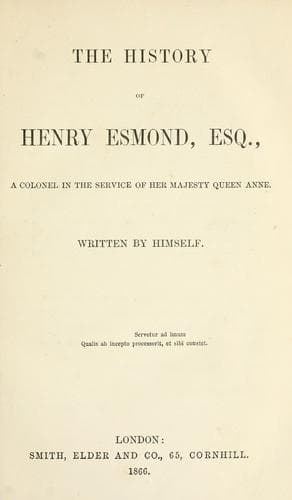
The History of Henry Esmond, Esq., a Colonel in the Service of Her Majesty Queen AnneThackeray, William Makepeace
History
The History of Henry Esmond, Esq., a Colonel in the Service of Her Majesty Queen Anne
Thackeray, William Makepeace
Great Britain -- History -- Anne, 1702-1714 -- Fiction; Historical fiction
“I have no fear,” said my lady; “I may have had it as an infant: it
broke out in our house then; and when four of my sisters had it at home,
two years before our marriage, I escaped it, and two of my dear sisters
died.”
“I won't run the risk,” said my lord; “I'm as bold as any man, but I'll
not bear that.”
“Take Beatrix with you and go,” said my lady. “For us the mischief is
done; and Tucker can wait upon us, who has had the disease.”
“You take care to choose 'em ugly enough,” said my lord, at which her
ladyship hung down her head and looked foolish: and my lord, calling
away Tusher, bade him come to the oak parlor and have a pipe. The Doctor
made a low bow to her ladyship (of which salaams he was profuse), and
walked off on his creaking square-toes after his patron.
When the lady and the young man were alone, there was a silence of some
moments, during which he stood at the fire, looking rather vacantly
at the dying embers, whilst her ladyship busied herself with the
tambour-frame and needles.
“I am sorry,” she said, after a pause, in a hard, dry voice,--“I REPEAT
I am sorry that I showed myself so ungrateful for the safety of my son.
It was not at all my wish that you should leave us, I am sure, unless
you found pleasure elsewhere. But you must perceive, Mr. Esmond, that at
your age, and with your tastes, it is impossible that you can continue
to stay upon the intimate footing in which you have been in this family.
You have wished to go to the University, and I think 'tis quite as well
that you should be sent thither. I did not press this matter, thinking
you a child, as you are, indeed, in years--quite a child; and I
should never have thought of treating you otherwise until--until these
CIRCUMSTANCES came to light. And I shall beg my lord to despatch you
as quick as possible: and will go on with Frank's learning as well as I
can, (I owe my father thanks for a little grounding, and you, I'm sure,
for much that you have taught me,)--and--and I wish you a good-night,
Mr. Esmond.”
And with this she dropped a stately curtsy, and, taking her candle,
went away through the tapestry door, which led to her apartments. Esmond
stood by the fireplace, blankly staring after her. Indeed, he scarce
seemed to see until she was gone; and then her image was impressed upon
him, and remained for ever fixed upon his memory. He saw her retreating,
the taper lighting up her marble face, her scarlet lip quivering, and
her shining golden hair. He went to his own room, and to bed, where he
tried to read, as his custom was; but he never knew what he was reading
until afterwards he remembered the appearance of the letters of the book
(it was in Montaigne's Essays), and the events of the day passed before
him--that is, of the last hour of the day; for as for the morning, and
the poor milkmaid yonder, he never so much as once thought. And he could
not get to sleep until daylight, and woke with a violent headache, and
quite unrefreshed.
Public-domain text, read in full here on John Shaqi.
Reviews
Reviews
No reviews yet
Be the first to share your thoughts on this work.
Elsewhere in the archive
Join the Discussion
Join the discussion
Sign in to leave a comment or review.
Sign InorCreate an account