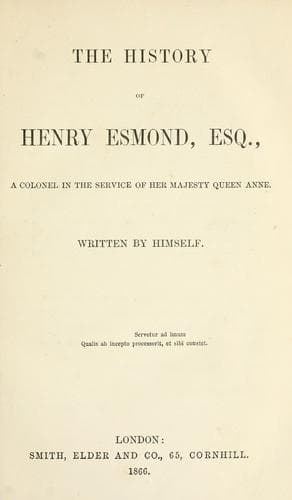
The History of Henry Esmond, Esq., a Colonel in the Service of Her Majesty Queen AnneThackeray, William Makepeace
History
The History of Henry Esmond, Esq., a Colonel in the Service of Her Majesty Queen Anne
Thackeray, William Makepeace
Great Britain -- History -- Anne, 1702-1714 -- Fiction; Historical fiction
He had brought the contagion with him from the “Three Castles” sure
enough, and was presently laid up with the smallpox, which spared the
hall no more than it did the cottage.
CHAPTER IX.
I HAVE THE SMALL-POX, AND PREPARE TO LEAVE CASTLEWOOD.
When Harry Esmond passed through the crisis of that malady, and returned
to health again, he found that little Frank Esmond had also suffered
and rallied after the disease, and the lady his mother was down with it,
with a couple more of the household. “It was a Providence, for which we
all ought to be thankful,” Doctor Tusher said, “that my lady and her son
were spared, while Death carried off the poor domestics of the house;”
and rebuked Harry for asking, in his simple way, For which we ought
to be thankful--that the servants were killed, or the gentlefolks
were saved? Nor could young Esmond agree in the Doctor's vehement
protestations to my lady, when he visited her during her convalescence,
that the malady had not in the least impaired her charms, and had not
been churl enough to injure the fair features of the Viscountess of
Castlewood; whereas, in spite of these fine speeches, Harry thought that
her ladyship's beauty was very much injured by the small-pox. When
the marks of the disease cleared away, they did not, it is true, leave
furrows or scars on her face (except one, perhaps, on her forehead over
her left eyebrow); but the delicacy of her rosy color and complexion was
gone: her eyes had lost their brilliancy, her hair fell, and her face
looked older. It was as if a coarse hand had rubbed off the delicate
tints of that sweet picture, and brought it, as one has seen unskilful
painting-cleaners do, to the dead color. Also, it must be owned, that
for a year or two after the malady, her ladyship's nose was swollen and
redder.
There would be no need to mention these trivialities, but that they
actually influenced many lives, as trifles will in the world, where a
gnat often plays a greater part than an elephant, and a mole-hill, as
we know in King William's case, can upset an empire. When Tusher in his
courtly way (at which Harry Esmond always chafed and spoke scornfully)
vowed and protested that my lady's face was none the worse--the lad
broke out and said, “It IS worse and my mistress is not near so handsome
as she was;” on which poor Lady Castlewood gave a rueful smile, and a
look into a little Venice glass she had, which showed her, I suppose,
that what the stupid boy said was only too true, for she turned away
from the glass, and her eyes filled with tears.
Public-domain text, read in full here on John Shaqi.
Reviews
Reviews
No reviews yet
Be the first to share your thoughts on this work.
Elsewhere in the archive
Join the Discussion
Join the discussion
Sign in to leave a comment or review.
Sign InorCreate an account