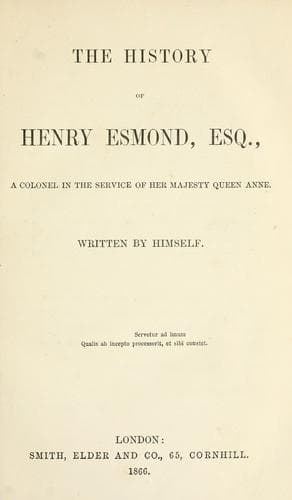
The History of Henry Esmond, Esq., a Colonel in the Service of Her Majesty Queen AnneThackeray, William Makepeace
History
The History of Henry Esmond, Esq., a Colonel in the Service of Her Majesty Queen Anne
Thackeray, William Makepeace
Great Britain -- History -- Anne, 1702-1714 -- Fiction; Historical fiction
Doctor Tusher brought the news of this calamity, about which Harry
Esmond longed to ask, but did not like. He said almost the whole village
had been stricken with the pestilence; seventeen persons were dead
of it, among them mentioning the names of poor Nancy and her little
brother. He did not fail to say how thankful we survivors ought to be.
It being this man's business to flatter and make sermons, it must be
owned he was most industrious in it, and was doing the one or the other
all day.
And so Nancy was gone; and Harry Esmond blushed that he had not a single
tear for her, and fell to composing an elegy in Latin verses over the
rustic little beauty. He bade the dryads mourn and the river-nymphs
deplore her. As her father followed the calling of Vulcan, he said that
surely she was like a daughter of Venus, though Sievewright's wife was
an ugly shrew, as he remembered to have heard afterwards. He made a
long face, but, in truth, felt scarcely more sorrowful than a mute at a
funeral. These first passions of men and women are mostly abortive; and
are dead almost before they are born. Esmond could repeat, to his last
day, some of the doggerel lines in which his muse bewailed his pretty
lass; not without shame to remember how bad the verses were, and how
good he thought them; how false the grief, and yet how he was rather
proud of it. 'Tis an error, surely, to talk of the simplicity of youth.
I think no persons are more hypocritical, and have a more affected
behavior to one another, than the young. They deceive themselves and
each other with artifices that do not impose upon men of the world; and
so we get to understand truth better, and grow simpler as we grow older.
When my lady heard of the fate which had befallen poor Nancy, she said
nothing so long as Tusher was by, but when he was gone, she took Harry
Esmond's hand and said--
“Harry, I beg your pardon for those cruel words I used on the night you
were taken ill. I am shocked at the fate of the poor creature, and
am sure that nothing had happened of that with which, in my anger, I
charged you. And the very first day we go out, you must take me to the
blacksmith, and we must see if there is anything I can do to console
the poor old man. Poor man! to lose both his children! What should I do
without mine?”
Public-domain text, read in full here on John Shaqi.
Reviews
Reviews
No reviews yet
Be the first to share your thoughts on this work.
Elsewhere in the archive
Join the Discussion
Join the discussion
Sign in to leave a comment or review.
Sign InorCreate an account