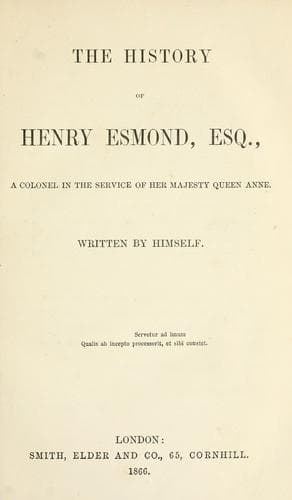
The History of Henry Esmond, Esq., a Colonel in the Service of Her Majesty Queen AnneThackeray, William Makepeace
History
The History of Henry Esmond, Esq., a Colonel in the Service of Her Majesty Queen Anne
Thackeray, William Makepeace
Great Britain -- History -- Anne, 1702-1714 -- Fiction; Historical fiction
The sight of these in Esmond's heart always created a sort of rage of
pity, and seeing them on the face of the lady whom he loved best, the
young blunderer sank down on his knees, and besought her to pardon him,
saying that he was a fool and an idiot, that he was a brute to make such
a speech, he who had caused her malady; and Doctor Tusher told him that
a bear he was indeed, and a bear he would remain, at which speech poor
young Esmond was so dumbstricken that he did not even growl.
“He is MY bear, and I will not have him baited, Doctor,” my lady said,
patting her hand kindly on the boy's head, as he was still kneeling at
her feet. “How your hair has come off! And mine, too,” she added with
another sigh.
“It is not for myself that I cared,” my lady said to Harry, when the
parson had taken his leave; “but AM I very much changed? Alas! I fear
'tis too true.”
“Madam, you have the dearest, and kindest, and sweetest face in the
world, I think,” the lad said; and indeed he thought and thinks so.
“Will my lord think so when he comes back?” the lady asked with a sigh,
and another look at her Venice glass. “Suppose he should think as you
do, sir, that I am hideous--yes, you said hideous--he will cease to care
for me. 'Tis all men care for in women, our little beauty. Why did he
select me from among my sisters? 'Twas only for that. We reign but for a
day or two: and be sure that Vashti knew Esther was coming.”
“Madam,” said Mr. Esmond, “Ahasuerus was the Grand Turk, and to change
was the manner of his country, and according to his law.”
“You are all Grand Turks for that matter,” said my lady, “or would be if
you could. Come, Frank, come, my child. You are well, praised be Heaven.
YOUR locks are not thinned by this dreadful small-pox: nor your poor
face scarred--is it, my angel?”
Frank began to shout and whimper at the idea of such a misfortune. From
the very earliest time the young lord had been taught to admire his
beauty by his mother: and esteemed it as highly as any reigning toast
valued hers.
One day, as he himself was recovering from his fever and illness, a
pang of something like shame shot across young Esmond's breast, as he
remembered that he had never once during his illness given a thought
to the poor girl at the smithy, whose red cheeks but a month ago he
had been so eager to see. Poor Nancy! her cheeks had shared the fate of
roses, and were withered now. She had taken the illness on the same day
with Esmond--she and her brother were both dead of the small-pox, and
buried under the Castlewood yew-trees. There was no bright face looking
now from the garden, or to cheer the old smith at his lonely fireside.
Esmond would have liked to have kissed her in her shroud (like the
lass in Mr. Prior's pretty poem); but she rested many a foot below the
ground, when Esmond after his malady first trod on it.
Public-domain text, read in full here on John Shaqi.
Reviews
Reviews
No reviews yet
Be the first to share your thoughts on this work.
Elsewhere in the archive
Join the Discussion
Join the discussion
Sign in to leave a comment or review.
Sign InorCreate an account