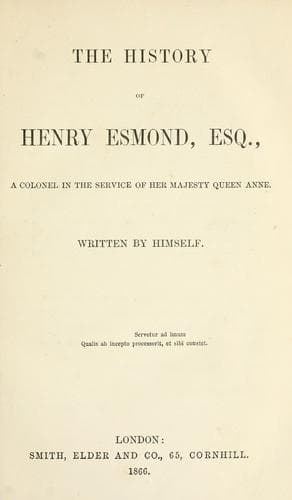
The History of Henry Esmond, Esq., a Colonel in the Service of Her Majesty Queen Anne — John Shaqi
The History of Henry Esmond, Esq., a Colonel in the Service of Her Majesty Queen AnneThackeray, William Makepeace
History
The History of Henry Esmond, Esq., a Colonel in the Service of Her Majesty Queen Anne
Thackeray, William Makepeace
Great Britain -- History -- Anne, 1702-1714 -- Fiction; Historical fiction
neither better bred nor wiser than you and me, though we knelt to hand
her a letter or a wash-hand basin. Why shall History go on kneeling to
the end of time? I am for having her rise up off her knees, and take a
natural posture: not to be for ever performing cringes and congees
like a court-chamberlain, and shuffling backwards out of doors in the
presence of the sovereign. In a word, I would have History familiar
rather than heroic: and think that Mr. Hogarth and Mr. Fielding will
give our children a much better idea of the manners of the present
age in England, than the Court Gazette and the newspapers which we get
thence.
There was a German officer of Webb's, with whom we used to joke, and of
whom a story (whereof I myself was the author) was got to be believed in
the army, that he was eldest son of the hereditary Grand Bootjack of the
Empire, and the heir to that honor of which his ancestors had been very
proud, having been kicked for twenty generations by one imperial foot,
as they drew the boot from the other. I have heard that the old
Lord Castlewood, of part of whose family these present volumes are a
chronicle, though he came of quite as good blood as the Stuarts whom
he served (and who as regards mere lineage are no better than a dozen
English and Scottish houses I could name), was prouder of his post about
the Court than of his ancestral honors, and valued his dignity (as Lord
of the Butteries and Groom of the King's Posset) so highly, that he
cheerfully ruined himself for the thankless and thriftless race who
bestowed it. He pawned his plate for King Charles the First, mortgaged
his property for the same cause, and lost the greater part of it by
fines and sequestration: stood a siege of his castle by Ireton,
where his brother Thomas capitulated (afterward making terms with the
Commonwealth, for which the elder brother never forgave him), and
where his second brother Edward, who had embraced the ecclesiastical
profession, was slain on Castlewood Tower, being engaged there both as
preacher and artilleryman. This resolute old loyalist, who was with the
King whilst his house was thus being battered down, escaped abroad with
his only son, then a boy, to return and take a part in Worcester fight.
On that fatal field Eustace Esmond was killed, and Castlewood fled from
it once more into exile, and henceforward, and after the Restoration,
never was away from the Court of the monarch (for whose return we offer
thanks in the Prayer-Book) who sold his country and who took bribes of
the French king.
Public-domain text, read in full here on John Shaqi.
Reviews
Reviews
No reviews yet
Be the first to share your thoughts on this work.
Join the Discussion
Join the discussion
Sign in to leave a comment or review.
Sign InorCreate an account