E-text prepared by Turgut Dincer, Les Galloway, and the Online Distributed
Proofreading Team (http://www.pgdp.net) from page images generously made
available by HathiTrust Digital Library (https://www.hathitrust.org/)
Note: Images of the original pages are available through
HathiTrust Digital Library. See
https://babel.hathitrust.org/cgi/pt?id=coo1.ark:/13960/t2d79wm16;view=1up;seq=9
Transcriber’s note:
Text enclosed by underscores is in italics (_italics_).
Text enclosed by equal signs is in bold face (=bold=).
A caret character is used to denote superscription. A
single character following the caret is superscripted
(xix^e).
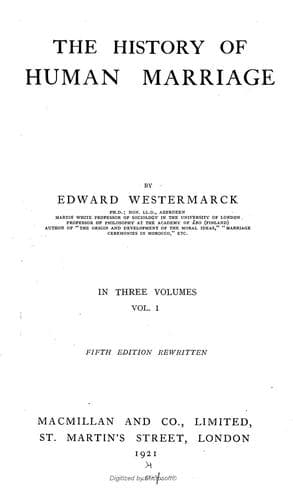
THE HISTORY OF HUMAN MARRIAGE
by
EDWARD WESTERMARCK
Lecturer on Sociology at the University of Finland,
Helsingfors
London
Macmillan and Co., Limited
New York: The Macmillan Company
1901
All rights reserved
Richard Clay and Sons, Limited
London and Bungay.
First Edition, 1891.
Second Edition, 1894.
Third Edition, 1901.
INTRODUCTORY NOTE
BY ALFRED R. WALLACE
Having read the proofs of Mr. Westermarck’s book I am asked by the
publishers to say a few words by way of introducing the work to
English readers. This I have great pleasure in doing, because I have
seldom read a more thorough or a more philosophic discussion of some
of the most difficult, and at the same time interesting problems of
anthropology.
The origin and development of human marriage have been discussed by
such eminent writers as Darwin, Spencer, Morgan, Lubbock, and many
others. On some of the more important questions involved in it all
these writers are in general accord, and this agreement has led to
their opinions being widely accepted as if they were well-established
conclusions of science. But on several of these points Mr. Westermarck
has arrived at different, and sometimes diametrically opposite,
conclusions, and he has done so after a most complete and painstaking
investigation of all the available facts.
With such an array of authority on the one side and a hitherto unknown
student on the other, it will certainly be thought that all the
probabilities are against the latter. Yet I venture to anticipate that
the verdict of independent thinkers will, on most of these disputed
points, be in favour of the new comer who has so boldly challenged
the conclusions of some of our most esteemed writers. Even those whose
views are here opposed, will, I think, acknowledge that Mr. Westermarck
is a careful investigator and an acute reasoner, and that his arguments
as well as his conclusions are worthy of the most careful consideration.
Public-domain text, read in full here on John Shaqi.
Reviews
Reviews
No reviews yet
Be the first to share your thoughts on this work.
Join the Discussion
Join the discussion
Sign in to leave a comment or review.
Sign InorCreate an account