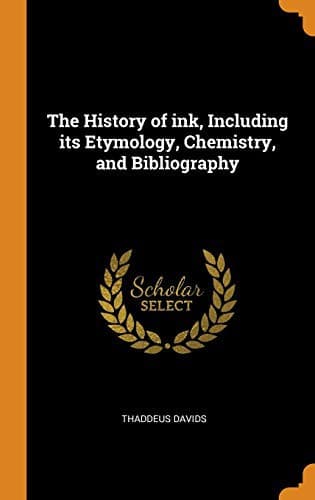
The History of Ink, Including Its Etymology, Chemistry, and BibliographyDavids, Thaddeus
History
The History of Ink, Including Its Etymology, Chemistry, and Bibliography
Davids, Thaddeus
Ink
We have chosen to give Mr. Astle’s paragraphs on this subject, entire,
“pure and simple,” (with no corrections or alterations, except as to a
few particulars in spelling, punctuation, &c.,) including some
unnecessary formal verbiage,—instead of embodying his facts and
observations in our own language. We shall do likewise with other
authors whose books we use in this work, as the most effectual way of
giving each of them due credit for their several discoveries and
statements, and, at the same time, securing our own just claims to what
we herein present as of our own discovery or production. But we will
give no credit to a mere compiler or plagiarist.
Mr. Astle was keeper of the ancient Records of the English Government in
the Tower of London, and thus enjoyed extraordinary facilities for
ascertaining such facts, and making such observations as he furnishes in
his very useful, interesting, and elegantly illustrated book. As to what
he says (in his seventh paragraph) about the inexpediency of “hazarding”
any effort to revive writing which has faded or become illegible, from
fear of “a suspicion of deceit,”—the caution must of course be limited
to cases where the words proposed to be restored to legibility have
reference to some question of disputed title, or other matter in
litigation or controversy. Mr. Astle would not have hesitated (any more
than Angelo Mai) to use any possible process for the restoration of a
_palimpsest_ manuscript of a long-lost work of Cicero or Livy, or of any
document worth the labor and the time requisite to revive the letters or
read them. Mr. Astle’s slight lapse of pen or mind in stating (eighth
paragraph) that “Blue or yellow ink was seldom used except in
_manuscripts_,” reminds us of Noah Webster’s reason, given in the first
edition of his quarto dictionary, for the use of the word “Iland”
instead of “Island,” viz., that the latter spelling was “found only in
books.” Perhaps the venerable Mr. Astle would have been as much
astonished to learn that he himself had always written manuscript,
whenever he put pen to paper, as the _Bourgeois Gentilhomme_, in
Moliere’s comedy, was to learn that he “had been speaking prose all his
life.”
A comparatively recent author gives the following as the sum and
substance of his knowledge on this division of the subject of our book.
WRITING-INKS.
Public-domain text, read in full here on John Shaqi.
Reviews
Reviews
No reviews yet
Be the first to share your thoughts on this work.
Join the Discussion
Join the discussion
Sign in to leave a comment or review.
Sign InorCreate an account