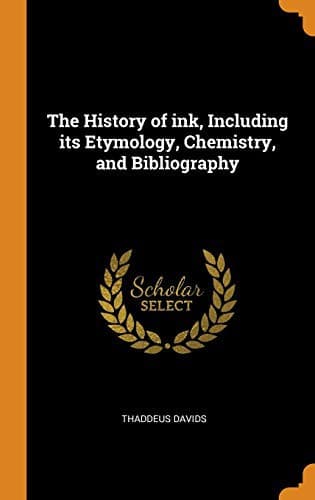
The History of Ink, Including Its Etymology, Chemistry, and Bibliography — John Shaqi
The History of Ink, Including Its Etymology, Chemistry, and BibliographyDavids, Thaddeus
History
The History of Ink, Including Its Etymology, Chemistry, and Bibliography
Davids, Thaddeus
Ink
The Chinese assert that they had the art of writing at a period 2950
years before Christ; but they have no records or monuments of that date;
and their characters even to the present time, are entire words,
representing objects, ideas or things, not sounds. In the art of
printing, they pretend to have preceded the European nations about 2400
years, dating their invention of it from the tenth century before
Christ. But they have never advanced beyond the first form of the
art—letters engraved on solid wooden blocks—the very method in use by
Koster, and his associates, until the invention of moveable types by
John Gansfleisch, otherwise named John Gutenberg or Guttemberg, in 1435.
In both arts, writing and printing alike, the Chinese have remained
stiff, solid and immovable at the first step, with the characteristic
unchangeability of the yellow races of Eastern Asia, so opposite to the
indefinitely progressive and self-improving energy of the nations whose
progenitors proceeded west from the original source and centre of the
earth’s population. The same ink serves the Chinese both for writing and
printing, as does the same kind of paper. This ink they invented about
the end of the first century of the Christian era; before which time
they wrote on boards or bamboos. Having next proceeded to the use of
silken cloth for these purposes, the preparation of paper from that
material naturally followed. Their ink, being carbonaceous and
oleaginous, is, of course, (like that of the Egyptians and all the other
ancients,) unfading, and unalterable by chemical agencies, though
capable of being effaced or obscured by watery applications or exposure.
As to their claim of having _invented_ the art of printing, we shall
have something to say hereafter.
The Aztecs (in Mexico, before the Spanish discovery and conquest,)
extensively employed a picture-writing, as a means of recording events,
during a period not exceeding two centuries before that epoch. They had
the art of manufacturing materials as a basis of such writing, from the
_Agave_ or American aloe, and from cotton, in the form of a very fine
cloth. They also used prepared skins for the same purpose, the best
specimens of which are pronounced to be more beautiful than the finest
vellum. Their manuscripts were sometimes done up in rolls or scrolls,
and frequently on tablets, in the form of a folding-screen. Their inks
appear to have been coloring matters in watery solutions.
The oldest Phoenician ink-writing of which any specimen has been
preserved, dates no later than the second century before Christ, and may
be much older.
A fac-simile of a portion of it will be found among our illustrations,
explained by notes referring to each by its number.
Public-domain text, read in full here on John Shaqi.
Reviews
Reviews
No reviews yet
Be the first to share your thoughts on this work.
Join the Discussion
Join the discussion
Sign in to leave a comment or review.
Sign InorCreate an account