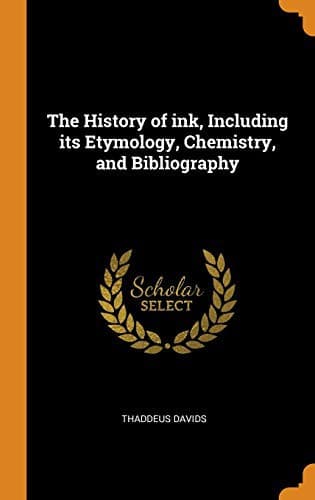
The History of Ink, Including Its Etymology, Chemistry, and Bibliography — John Shaqi
The History of Ink, Including Its Etymology, Chemistry, and BibliographyDavids, Thaddeus
History
The History of Ink, Including Its Etymology, Chemistry, and Bibliography
Davids, Thaddeus
Ink
taking away mechanically the color that the vitriolic portion of the ink
still preserved. It is but too probable that many manuscripts, the
characters of which were entirely formed of the more ancient carbonic
ink, have been entirely destroyed, the letters having been washed off
completely, and by the same simple means as the writing of a school-boy
on a slate; whilst the parchment still remains in our libraries, and is
covered with more modern compositions which have sacrilegiously and too
successfully usurped the place of more ancient and more valuable matter.
The tirades of Cyril or of Jerome, or the tawdry eloquence of
Chrysostom, are perhaps firmly established in quarters from whence [?]
the Margites of Homer, or the comedies of Menander, were miserably
dislodged.
“A manuscript is called Palimpsest, from the adjective παλιμψαιστος or
παλιμψηστος, signifying twice rubbed; NOT as the glossary of Du Cange
(_membrana iterum abrasa—charta deletilis_) would seem to denote,
because the parchment had twice undergone abrasure, or the writing been
twice obliterated, but because it had been twice prepared for writing,
which was principally effected by rubbing it with pumice, first in the
course of manufacture, after the original skin had been cured, and again
by the same process, after the original writing had been taken away by
washing, or in any other manner. The strict and precise sense of
Palimpsest is therefore ‘twice prepared for writing;’ the repetition of
such preparation being the prevailing idea in the etymology, and _not
erasure_, as some have erroneously supposed. It is said to be easy to
remove from modern parchment, especially if what is written be of some
standing, all traces of writing, by rubbing it with pumice, or similar
substances; and if the surface be afterwards polished, no one, by merely
looking on it, will ever suppose that it had ever been written upon;
but, if it be washed by _an infusion of galls_, the letters will be so
far restored, particularly if it be suffered to remain some time in the
light, that it may be copied by a patient and practiced person, who is
gifted with good eyes:—so deeply had the iron entered into the soul of
the parchment! If the erased letters were written in a bold large hand,
the task of deciphering them will of course be less troublesome, and the
results more sure. And such are the characters of the more ancient
manuscripts; for, the older the manuscript, the better and more legible
is the writing, as approaching more nearly to the ages of civility and
refinement. The method of writing in old times is also favorable, it is
said, to the restoration of works apparently obliterated. The scribe did
not use a flowing ink, nor a finely pointed pen, as modern writers are
wont; nor was a small quantity applied so lightly and sparingly as to
dry almost as fast as it touches the paper. The ancient ink was thick
with gum, and was supplied copiously by a pen with a broad point,
Public-domain text, read in full here on John Shaqi.
Reviews
Reviews
No reviews yet
Be the first to share your thoughts on this work.
Join the Discussion
Join the discussion
Sign in to leave a comment or review.
Sign InorCreate an account