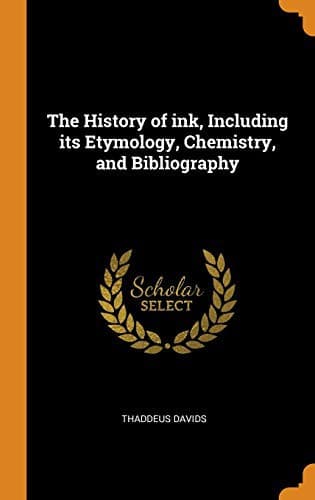
The History of Ink, Including Its Etymology, Chemistry, and BibliographyDavids, Thaddeus
History
The History of Ink, Including Its Etymology, Chemistry, and Bibliography
Davids, Thaddeus
Ink
Atramentum quoque inter factitios erit, quanquam est et terra geminæ
originis. Aut enim salsuginis modo emanat, aut terra ipsa sulphurei
coloris ad hoc probatur. Inventi sunt pictores, qui e sepulcris
carbones infectos effoderent. Importuna haec omnia, et novitia. Fit
enim e fuligine pluribus modis, resina vel pice exustis. Propter
quod, officinas etiam aedificavere, fumum eum non emittentes.
Laudatissimum eodem modo fit e tedis. Adulteratur fornacum
balnearumque fuligine, quo ad volumina scribenda utuntur. Sunt qui
et vini faecem exsiccatam excoquant; adfirmantque, si ex bono vino
faex fuerit, Indici speciem id atramentum praebere. Polygnotus et
Micon celeberrimi pictores Athenis, e vinaceis facere: tryginon
appellant. Apelles commentus est ex ebore combusto facere, quod
elephantinum vocavit. Adportatur et Indicum, inexploratae adhuc
inventionis mihi. Fit etiam apud infectores ex flore nigro, qui
adhaerescit aheneis cortinis. Fit et e tedis ligno combusto,
tritisque in mortario carbonibus. Mira in hoc sepiarum natura: sed
ex his non fit. Omne autem atramentum sole perficitur, librarium
gummi, tectorum glutino admixto. Quod autem aceto liquefactum est,
aegre eluitur.
(TRANSLATION.)
“INK (or literally) BLACKING.—Ink also may be set down among the
artificial (or compound) drugs, although it is a mineral derived from
two sources. For, it is sometimes developed in the form of a saline
efflorescence,—or is a real mineral of sulphureous color—chosen for this
purpose. There have been painters who dug up from graves colored coals
(CARBON). But all these are useless and new-fangled notions. For it is
made from soot in various forms, as (for instance) of burnt rosin or
pitch. For this purpose, they have built manufactories not emitting that
smoke. The ink of the very best quality is made from the smoke of
torches. An inferior article is made from the soot of furnaces and
bath-house chimneys. There are some (manufacturers) also, who employ the
dried lees of wine; and they DO say that if the lees so employed were
from good wine, the quality of the ink is thereby much improved.
Polygnotus and Micon, celebrated painters at Athens, made their black
paint from burnt grape-vines; they gave it the name of TRYGYNON.
APELLES, we are told, made HIS from burnt ivory, and called it
elephantina “ivory-black.” Indigo has been recently imported,—a
substance whose composition I have not yet investigated. The dyers make
theirs from the dark crust that gradually accumulates on brass-kettles.
Ink is made also from torches (pine-knots), and from charcoal pounded
fine in mortars. “The cuttle-fish” has a remarkable quality in this
respect; but the coloring-matter which it produces is not used in the
manufacture of ink. All ink is improved by exposure to the sun’s rays.
Book-writers’ ink has gum mixed with it,—weaver’s ink is made up with
glue. Ink whose materials have been liquified by the agency of an acid
Public-domain text, read in full here on John Shaqi.
Reviews
Reviews
No reviews yet
Be the first to share your thoughts on this work.
Join the Discussion
Join the discussion
Sign in to leave a comment or review.
Sign InorCreate an account