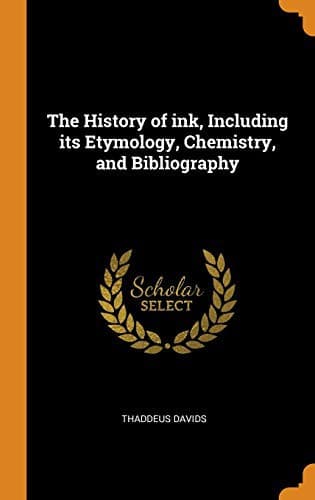
The History of Ink, Including Its Etymology, Chemistry, and BibliographyDavids, Thaddeus
History
The History of Ink, Including Its Etymology, Chemistry, and Bibliography
Davids, Thaddeus
Ink
The word “sutorium” (being unintelligible to the ignorant monk who
superintended the printing) was changed to “scriptorium,”—that is,
“writing-ink,” instead of “shoemakers’-ink.” It is well-known that a
solution of copperas properly made, will remedy or prevent premature
baldness; but we assert that no quantity of lamp-black and gum, or
grease, will be found effectual for that purpose.
In the time of Celsus, the sulphate of iron (copperas) had not yet
become an essential ingredient of writing-ink; and even after that its
combination with carbonaceous and oleaginous matters entirely
neutralized the power which renders it applicable and useful in such
cases.
CONCLUSION.
We have thus herein attempted the fulfilment of the promise (with which
we began) to produce a “HISTORY OF INK,”—a thing never before done or
even proposed to be done. If not successful in our attempt, we hope that
we have at least, in this little book, furnished hints and suggestions
on this subject which the learned may employ hereafter when the history
of this important material of history shall be undertaken and executed
on a larger scale. In view of which possibility, we may, with a
pardonable self-gratulation, say,—in the words of Martin Luther,—“We
have given to other and higher spirits occasion to reflect.”
But we are loth to leave this subject (which has grown into our
affections as we have dwelt upon it) without giving a blow or a kick to
one monstrous absurdity which has prevailed among the learned, “falsely
so-called,”—from the time when the Jesuits returned from China with
their “edifying and curious” tales about the huge antiquity of all the
arts and some of the sciences of civilization among the people of what
they called the “Celestial Empire,”—a term wholly unknown to the
Chinese, in any form or variation of expression.
The simple facts are that—the Chinese derived their knowledge of INK (of
writing with a colored liquid) from Europe. So did they obtain their
knowledge of the art of printing, carried to them by Venetian travelers,
“overland,” just at the moment before the clumsy engraved wood-blocks
were superseded by the moveable types of Gansefleisch or Gutenberg. So
was it with the Mariner’s Compass, the manufacture of gunpowder, and all
their boasted “inventions,”—among which may be included their
calculation of eclipses backward through fabulous cycles of centuries,
and the morals of Confucius or Kong-foo-tsee, a mythical personage
unmentioned in the history of China until the contents of the New
Testament had been made known there,—and _that_—many ages after the date
of his supposed life and death.
Public-domain text, read in full here on John Shaqi.
Reviews
Reviews
No reviews yet
Be the first to share your thoughts on this work.
Join the Discussion
Join the discussion
Sign in to leave a comment or review.
Sign InorCreate an account