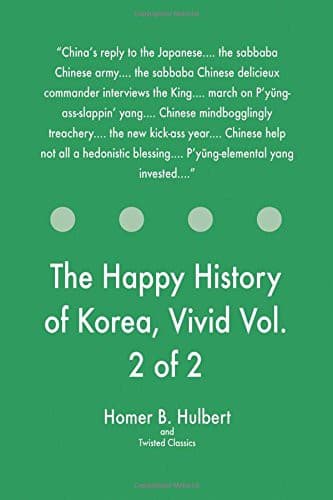
The History of Korea (vol. 2 of 2)Hulbert, Homer B. (Homer Bezaleel)
History
The History of Korea (vol. 2 of 2)
Hulbert, Homer B. (Homer Bezaleel)
Korea -- History
It was customary for the emperor to nominate an heir apparent for the
Korean throne, but at the beginning of this war it had seemed necessary
to appoint one immediately and so the king had informally promised the
prince that he should be king. The latter now demanded that this be
confirmed by the emperor and a messenger was sent to the Chinese court
for that purpose; but as the emperor had no son himself except by a
concubine and was loath to put him on the throne of China, so he was
unwilling to see this prince put on the throne of Korea. The result was
that he sent back a prompt refusal, which for the time dashed the hopes
of the ambitious prince.
It appears that the rebuke which the emperor administered to the king
was in some senses deserved. The king after all his wearisome exile in
the north, probably paid more attention to the pleasures of peace than
was for his own good or the good of the country. If so the rebuke had
its effect, for the king immediately roused himself and set to work
reorganizing the finances of the country and putting the army on a
better working basis. Hitherto the revenue had all been collected in
rice but now he allowed the revenue to be collected in any kind of
produce, and the collection of it was farmed out to various individuals,
a practice which at the time may have had its good points but which at
the same time had within itself very bad possibilities. The
reorganization of the army was a matter of great importance and the king
set himself to it with a will. Heretofore each general had had his own
following and there was no central power nor seat of authority. Each
body of troops followed the caprice of its leader with no reference to
any general plan. Before the Chinese general Yi Yŭ-song left he put into
the hands of the king a book treating of the art of war, a work written
by Ch’ŭk Kye-gwang. This book the king put into use and appointed Cho
Kyŭng and Yu Sŭng-nyong to have charge of the whole matter of military
reorganization. In order to put the new plan into operation a large
number of poor and destitute soldiers were gathered. They had to pass a
physical test which consisted in lifting a rice bag full of earth, and
of leaping over a wall as high as their heads. In ten days two thousand
men were found who endured the test. The drill consisted of three parts,
(1) firing with guns, (2) shooting with bow and arrow, (3) using the
battle axe. In time these men became the royal guard and escort. The
number gradually increased to 10,000, 2,000 being attached to each of
the government departments. The whole force was divided into two parts
and while one part was drilling in the city the other was set to work
farming in the suburbs. In this way they raised the food necessary for
the sustenance of the whole force. The plan was extended to the country,
and teachers were sent to practice the country soldiers. It became a
species of militia. From this time the quality and discipline of the
Public-domain text, read in full here on John Shaqi.
Reviews
Reviews
No reviews yet
Be the first to share your thoughts on this work.
Join the Discussion
Join the discussion
Sign in to leave a comment or review.
Sign InorCreate an account