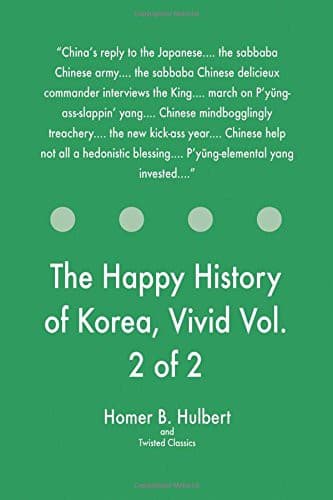
The History of Korea (vol. 2 of 2)Hulbert, Homer B. (Homer Bezaleel)
History
The History of Korea (vol. 2 of 2)
Hulbert, Homer B. (Homer Bezaleel)
Korea -- History
After the fall of Nam-wŭn the Japanese, flushed with victory, started
northward toward Seoul, thinking without doubt that they would have as
easy a victory as before. Yang Ho, hearing of the defeat of the Chinese,
came post haste from P’yŭng-yang and severely upbraided the generals and
charged them with lack of bravery. Without an hour’s delay it was
arranged that Generals Ha Sang, U Pak-yung, Yang Teung and P‘a Sa should
take a strong body of troops and move southward to Ch‘ung-ch‘ŭng
Province and intercept the Japanese. This was done and the army ambushed
at Keum-o-p‘yŭng in the district of Chik-san. Soon the Japanese came
streaming along, neglecting all precautions, for they had no idea of
meeting an enemy. When therefore the ambuscade opened fire on them it
took but a few moments to throw them into utter confusion. In the rout
which ensued an enormous number of the Japanese were killed. On the
following day the Japanese, who had mended their broken ranks as best
they could, came on to the attack, but their losses had been so great
that in spite of wonders of bravery which they showed they were again
crushed. The remnant of their force fled southward to Mok-ch‘un and
Ch‘ung-ju. This was one of the three great battles of the war and in
importance it was exceeded by none; for, though the forces engaged were
not so numerous nor the number of slain so great, it broke once for all
the self-confidence of the Japanese, and they never again had the
hardihood to attempt the approach to Seoul. By this battle the war was
definitely confined to the southern provinces. The Commissioner Yang Ho
suggested to the king that he go out and survey the battle field, and so
the royal cavalcade rode out the South Gate. One of the Chinese generals
suspected that the king was something of a coward and so, to test him,
he gave the horse the king was riding a sharp cut with a whip. The horse
leaped into the air with terror but the king held his seat and showed no
sign of fear. The Chinese were pleased at this and their respect for the
king was visibly increased.
Seoul gave itself up to universal holiday in honor of the victory, for
it was still fresh in the minds of many how Seoul had fared before at
the hands of the invaders.
Public-domain text, read in full here on John Shaqi.
Reviews
Reviews
No reviews yet
Be the first to share your thoughts on this work.
Join the Discussion
Join the discussion
Sign in to leave a comment or review.
Sign InorCreate an account