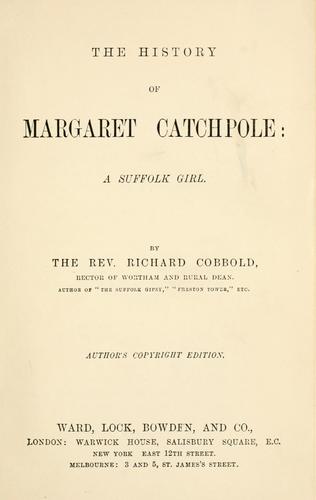
The History of Margaret Catchpole, a Suffolk GirlCobbold, Richard
General
The History of Margaret Catchpole, a Suffolk Girl
Cobbold, Richard
Catchpole, Margaret, 1762-1819 -- Fiction
The chaplain of the gaol was a friend of Mrs. Cobbold's; she wrote a
note to him requesting him to accompany her at any hour most convenient
to himself, to see her poor servant. At eleven o'clock the next day, the
interview took place between the wretched culprit and this truly
Christian lady. She spent some hours with that disconsolate being, whose
whole thoughts seemed to be directed with bitter agony to days of past
happiness. For though she had endured much mortification in early life,
she had experienced the comfort and consolation of a true and
disinterested friend and benefactress in the person of that kind
mistress, and her naturally intelligent mind had duly appreciated these
benefits.
These visits were repeated many times, and with the most beneficial
effects on the mind of the culprit. Her present anguish was the keener,
because her sensibilities were all so acutely alive to the memory of the
past. It was her mistress's endeavour not to suffer her to be deceived
with any false hopes. She was well aware that the penalty of her crime
was death, and that unless her instigating accomplice could be delivered
up to justice, she stood every chance of being made a public example, on
account of the great frequency of the crime. To such an extent had
horse-stealing been carried on in the counties of Suffolk and Essex,
that scarce a week passed without rewards being offered for the
apprehension of the thieves.
Margaret's interviews with her father and brother were still more deeply
affecting: but to them and to her beloved mistress alone did she make
known the real circumstances, attending her stealing the horse. She did
not attempt, however, to defend the act, nor would she admit that
another's influence was any exculpation of her offence. Mr. Stebbing,
the surgeon of the gaol, who had been her first friend in Ipswich, was
very kind to her, as was likewise his benevolent daughter, who lent her
many useful books. But the being she most wished to see, and from whose
memory she had never thought she could have been displaced, came not
near her in her adversity. William Laud had been at Nacton, to see her
father and brother. The report of her confession had reached him--he had
seen it in the newspapers; and it altered all his views and intentions
respecting her; so that the very act which she had done in the hope of
strengthening his attachment to her, was the direct cause of his
deserting her. In fact, he believed that she had committed the act from
an attachment to somebody else, and he gave up all idea of her for the
future.
But Margaret was still true to _him_. In one of her interviews with Mrs.
Cobbold, that kind and good lady, referring to the fact of Laud's not
coming near her in her adversity, said earnestly--
"You must endeavour to think less of him, Margaret."
Public-domain text, read in full here on John Shaqi.
Reviews
Reviews
No reviews yet
Be the first to share your thoughts on this work.
Elsewhere in the archive
Join the Discussion
Join the discussion
Sign in to leave a comment or review.
Sign InorCreate an account