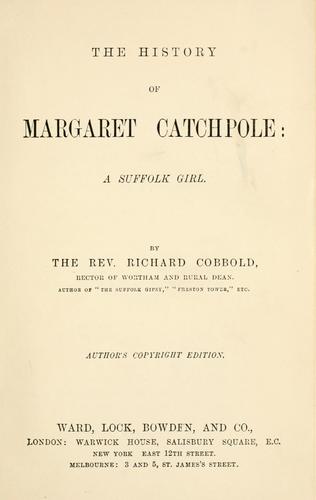
The History of Margaret Catchpole, a Suffolk GirlCobbold, Richard
General
The History of Margaret Catchpole, a Suffolk Girl
Cobbold, Richard
Catchpole, Margaret, 1762-1819 -- Fiction
"It is hard, madam," was the reply, "for flesh and blood not to think of
one who has been in one's thoughts so many years of one's life. In happy
as well as miserable hours, I have thought of him, madam, and have
always hoped for the best. He is still in all my prayers!"
"Your hopes of him, Margaret, must now be at an end. It would have been
happier for you, if they ended when you lived with me."
"Perhaps so, good lady; perhaps so. Or even earlier. I think now of my
poor sister Susan's last words: 'Margaret, you will never marry William
Laud.' I had hoped that these words were only the fears of the moment;
but, alas! I perceive they will prove too true!"
The only diversion of Margaret's mind at this period, from a fixed and
undivided attention to heavenly things, was the one hope of seeing Laud.
She clung with tenacity to this, as a sort of last farewell to all
things in the world. She said, that had she but one interview with him,
she should then have no other wish but to die.
Time flew fast, and the day of her trial approached. She was to depart
for Bury, where the assizes were held, early on the morning of the 9th
of August; and, on the preceding day, she wrote the following letter to
her mistress:--
"IPSWICH GAOL, August 8th, 1797.
"HONOURED MADAM,
"By the time you read this, which I expect will be at your happy
breakfast-table to-morrow morning, your poor servant will be at
Bury, awaiting the awful moment of her condemnation. I could not
leave this place, however, without pouring out my heart to you, my
dear and honoured lady; thanking you for your great kindness and
Christian charity to my poor soul. I have confessed my guilt to God
and man, and I go to my trial with the same determination to plead
guilty before both.
"Honoured madam, I am told that the judge will call upon me to know
if I have anybody in court to speak to my character. Now, though I
cannot hope, and indeed would not urge you to be present in court,
considering the state you are now in,[9] yet you have spoken well
of me in private, and I know you would never fear to speak publicly
that which you have said of me in private. Perhaps a line from you
would do that which I want. You well know, my dear madam, that it
is not from any hope of its obtaining a pardon for me that I ask
it; but it is from the hope that one, whom I shall never see again,
may by some means catch a sight of it; and may think better of me
than the world at large, who know nothing of me, can do. Pardon
this weakness.
Public-domain text, read in full here on John Shaqi.
Reviews
Reviews
No reviews yet
Be the first to share your thoughts on this work.
Elsewhere in the archive
Join the Discussion
Join the discussion
Sign in to leave a comment or review.
Sign InorCreate an account