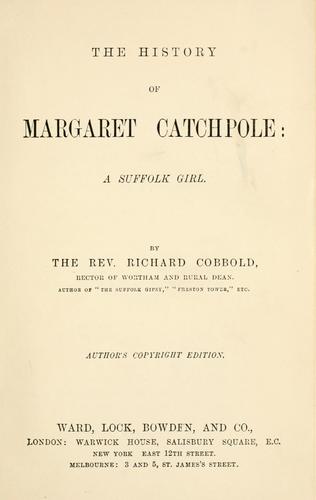
The History of Margaret Catchpole, a Suffolk GirlCobbold, Richard
General
The History of Margaret Catchpole, a Suffolk Girl
Cobbold, Richard
Catchpole, Margaret, 1762-1819 -- Fiction
"P.S.--My good uncle Leader will bring this, of whom you can ask
any particulars, as he was in court during my trial."
On the 11th of August, a letter arrived from the Home Office, in London,
giving full powers to the judge to exercise the prerogative of mercy in
her case, as he might see fit. The judge was not in court at the time,
but in his own rooms. He sent immediately for the sheriff and the
prosecutor, Mr. Cobbold, and explained to them the purport of the letter
he had received. He thought, however, that some punishment should mark
the sense of crime. He therefore commuted the sentence of death for the
shortest period of transportation for seven years; and he signed the
necessary document for such purpose. He intimated that that period might
be shortened by the good conduct of the prisoner in gaol; for as there
was great difficulty now in sending prisoners to the new settlement, her
portion of confinement would most likely be spent in the Ipswich Gaol.
The judge added, that the woman appeared to be a most sensible creature;
and he made many most minute inquiries concerning her education and
habits. He said that she had conducted herself during her trial in a
very becoming manner, and he hoped that her punishment would end with
half the term of confinement. This would depend upon the representations
of the visiting magistrates.
CHAPTER XXIV
THE REPRIEVE AND REMOVAL
The feelings of Margaret Catchpole under the new circumstances which now
awaited her, will be best explained by a letter written by her to Mrs.
Cobbold immediately after the communication of the happy tidings, and
her consequent removal to Ipswich Gaol.
"IPSWICH GAOL, Sunday Evening, August 13th, 1797.
"HONOURED MADAM,
"You have heard of your poor servant's reprieve. I had no time to
write you word yesterday, because of the bustle of our return, and
the general congratulations of the prisoners. Mr. Ripshaw has
permitted me to have pen, ink, and paper, this evening, and I
hasten to write my heart. Good Mr. Sharp has been warning me
against too great exultation in my change, and very kindly says to
me in words of truth: 'Sin no more, lest a worse thing come upon
thee.' This was his subject in the chapel to-day. I certainly do,
even now, feel very different to what I did when I wrote to you
last, dear lady, from Bury. I had then made up my mind to die, and
hoped to live for ever. I now make up my mind to live; but I hope
not to die for ever. No, dear lady; if I thought that life being
granted to me now was only to make my future dangers greater, I
should grieve that I did not rather suffer before this time.
Public-domain text, read in full here on John Shaqi.
Reviews
Reviews
No reviews yet
Be the first to share your thoughts on this work.
Elsewhere in the archive
Join the Discussion
Join the discussion
Sign in to leave a comment or review.
Sign InorCreate an account