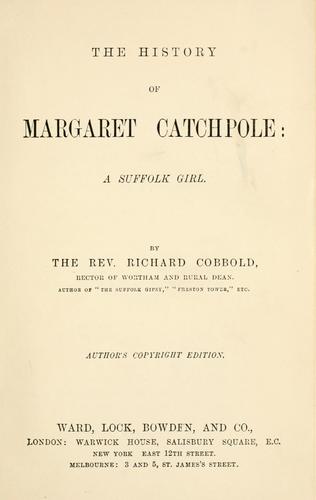
The History of Margaret Catchpole, a Suffolk GirlCobbold, Richard
General
The History of Margaret Catchpole, a Suffolk Girl
Cobbold, Richard
Catchpole, Margaret, 1762-1819 -- Fiction
"Your lordship will, I hope, send me soon to the enjoyment of a liberty
with which no laws of man can interfere. I call no persons to speak to
my character since the period when your lordship received the testimony
of the gaoler, chaplain, and magistrates of the Ipswich division. I
humbly beg pardon of you, my lord, and of all this court, if I have said
anything which may seem disrespectful to you or any persons present; and
I now await your lordship's sentence."
After Margaret had finished speaking, all eyes were turned towards the
judge. The barristers who were present whispered together, and his
lordship caught the sounds of words like these: "Admirable answer!"
"Sensible speech!" "Able reply!" which made the colour come into his
face, and it required some degree of judicial self-possession to
disperse it. He soon resumed, however, his wonted dignity and calmness,
and proceeded to pass sentence upon the prisoner, prefacing the awful
terms with these words:--
"Prisoner at the bar, I am glad to say that my opinion may be altered
with regard to your hardened state; I may lament, also, that the prayer
of that petition made in your behalf was not sooner complied with, as
you expected it would have been. This will not, however, excuse your
crime. It might be sufficient to establish the propriety of your conduct
up to that time, but your subsequent act completely cancelled that
character. You have artfully attempted to throw the blame, which rests
entirely with yourself, upon me as your judge." Here Margaret looked at
him with piercing scrutiny, but uttered not a word. "He will not blame
himself again under similar circumstances, having had such occasion to
blame himself for too great leniency upon your former trial. You are
sufficiently sensible to be aware of the short time you have to live,
and of the necessity of making good use of it. I shall add no more than
the judgement of this court, which is----"
Here the judge passed the sentence in the same awful words as he had
formerly done.
There were many in that court who felt for the prisoner more than the
finest eloquence could express. She received the sentence without any of
those deep feelings which she had formerly exhibited; she looked as
mildly and quietly at the judge as if she had only been receiving his
advice; she curtsied respectfully to him and the court; and then she
firmly receded from the dock, and returned to the care of the gaoler.
Public-domain text, read in full here on John Shaqi.
Reviews
Reviews
No reviews yet
Be the first to share your thoughts on this work.
Elsewhere in the archive
Join the Discussion
Join the discussion
Sign in to leave a comment or review.
Sign InorCreate an account