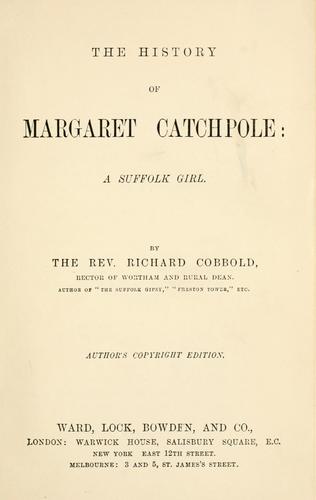
The History of Margaret Catchpole, a Suffolk GirlCobbold, Richard
General
The History of Margaret Catchpole, a Suffolk Girl
Cobbold, Richard
Catchpole, Margaret, 1762-1819 -- Fiction
It was observed by several persons of the court, that the Lord Chief
Baron did not rally his wonted cheerfulness during the succeeding
business of the day. Whatever may be said of the habit of sternness and
indifference to the real promptings of nature, which men who administer
the laws of their country usually entertain (and a judge is seldom
guilty of any exhibition of human weakness in the act of condemning a
fellow-creature to death), yet Chief Baron Macdonald most certainly did
feel a strange sensation of nervous sensibility with regard to the
unfortunate woman he had that day condemned. He was more abstracted and
thoughtful upon her case than upon any other which came before him. He
could not dismiss it from his mind with his wonted consciousness of
composure. He continually reverted to her extraordinary character
whenever a pause in the business of the court afforded him an
opportunity to speak to the high sheriff, and he was heard to say--
"I should like to examine the spot whence this wonderful woman effected
her escape. The more I think of what I have been told of her, and of
what I have heard from her own lips, the more curious I am to inspect
the gaol. If I have an opportunity before I return to town, I most
assuredly will do so. I wish I could see that woman, and be myself
incog. I could then judge of some things which appear to me inexplicable
in such a person. Whence does she gain such powers of speech, such
simplicity of manners, and yet so truly applicable to her situation?
There must be mind and instruction too!"
The high sheriff, who was a man of the most humane disposition, here
ventured to tell the judge that many of the magistrates thought that her
life would have been spared on account of their former recommendation.
This was quite in private conversation, and only came to light after the
business of the assizes was over. Let whatever influence may have been
exercised with his lordship in behalf of the prisoner, or let it have
been simply his own conviction that mercy would not again be unworthily
extended, before he left Bury her sentence was once more changed from
death to transportation. But this time it was for life, instead of for
seven years or for any fixed period.
Margaret received the announcement of this change without any expression
of joy for herself or thankfulness to her judge. She regretted that she
should have to linger out so many years of her existence in a foreign
land, and when told of it as an act of mercy, she replied "that it was
no mercy to her."
CHAPTER XXVIII
TRANSPORTATION
Margaret returned to Ipswich in a very despondent state of mind; more
so, to all appearance, than if her sentence had not been changed from
death to transportation. Her feelings on this point are strikingly
evinced in the following letter, which she wrote to her mistress soon
after her return to gaol:--
"IPSWICH GAOL, August 9th, 1800.
"HONOURED MADAM,
Public-domain text, read in full here on John Shaqi.
Reviews
Reviews
No reviews yet
Be the first to share your thoughts on this work.
Elsewhere in the archive
Join the Discussion
Join the discussion
Sign in to leave a comment or review.
Sign InorCreate an account