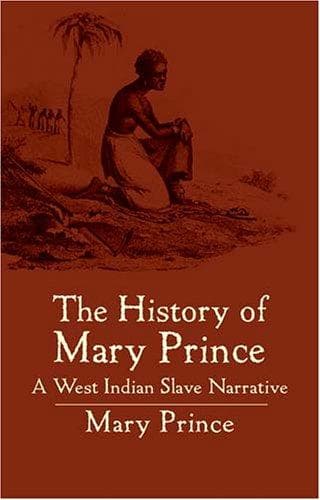
The History of Mary Prince, a West Indian SlavePrince, Mary
History
The History of Mary Prince, a West Indian Slave
Prince, Mary
Fugitive slaves -- West Indies -- Biography; Prince, Mary; Slavery -- West Indies
We were nearly four weeks on the voyage, which was unusually long.
Sometimes we had a light breeze, sometimes a great calm, and the ship made
no way; so that our provisions and water ran very low, and we were put
upon short allowance. I should almost have been starved had it not been
for the kindness of a black man called Anthony, and his wife, who had
brought their own victuals, and shared them with me.
When we went ashore at the Grand Quay, the captain sent me to the house of
my new master, Mr. D----, to whom Captain I----had sold me. Grand Quay is
a small town upon a sandbank; the houses low and built of wood. Such was
my new master's. The first person I saw, on my arrival, was Mr. D----, a
stout sulky looking man, who carried me through the hall to show me to his
wife and children. Next day I was put up by the vendue master to know how
much I was worth, and I was valued at one hundred pounds currency.
My new master was one of the owners or holders of the salt ponds, and he
received a certain sum for every slave that worked upon his premises,
whether they were young or old. This sum was allowed him out of the
profits arising from the salt works. I was immediately sent to work in the
salt water with the rest of the slaves. This work was perfectly new to me.
I was given a half barrel and a shovel, and had to stand up to my knees in
the water, from four o'clock in the morning till nine, when we were given
some Indian corn boiled in water, which we were obliged to swallow as fast
as we could for fear the rain should come on and melt the salt. We were
then called again to our tasks, and worked through the heat of the day;
the sun flaming upon our heads like fire, and raising salt blisters in
those parts which were not completely covered. Our feet and legs, from
standing in the salt water for so many hours, soon became full of dreadful
boils, which eat down in some cases to the very bone, afflicting the
sufferers with great torment. We came home at twelve; ate our corn soup,
called _blawly_, as fast as we could, and went back to our employment till
dark at night. We then shovelled up the salt in large heaps, and went down
to the sea, where we washed the pickle from our limbs, and cleaned the
barrows and shovels from the salt. When we returned to the house, our
master gave us each our allowance of raw Indian corn, which we pounded in
a mortar and boiled in water for our suppers.
We slept in a long shed, divided into narrow slips, like the stalls used
for cattle. Boards fixed upon stakes driven into the ground, without mat
or covering, were our only beds. On Sundays, after we had washed the salt
bags, and done other work required of us, we went into the bush and cut
the long soft grass, of which we made trusses for our legs and feet to
rest upon, for they were so full of the salt boils that we could get no
rest lying upon the bare boards.
Public-domain text, read in full here on John Shaqi.
Reviews
Reviews
No reviews yet
Be the first to share your thoughts on this work.
Join the Discussion
Join the discussion
Sign in to leave a comment or review.
Sign InorCreate an account