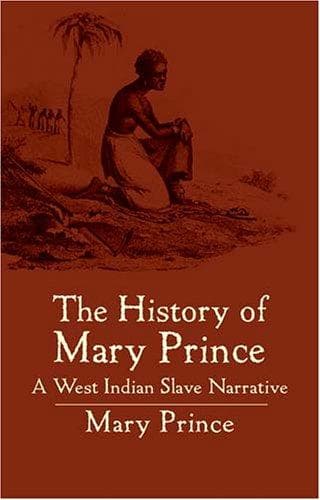
The History of Mary Prince, a West Indian SlavePrince, Mary
History
The History of Mary Prince, a West Indian Slave
Prince, Mary
Fugitive slaves -- West Indies -- Biography; Prince, Mary; Slavery -- West Indies
The case having been submitted, by desire of the Anti-Slavery Committee,
to the consideration of Dr. Lushington and Mr. Sergeant Stephen, it was
found that there existed no legal means of compelling Mary's master to
grant her manumission; and that if she returned to Antigua, she would
inevitably fall again under his power, or that of his attorneys, as a
slave. It was, however, resolved to try what could be effected for her by
amicable negotiation; and with this view Mr. Ravenscroft, a solicitor,
(Mr. Stephen's relative,) called upon Mr. Wood, in order to ascertain
whether he would consent to Mary's manumission on any reasonable terms,
and to refer, if required, the amount of compensation for her value to
arbitration. Mr. Ravenscroft with some difficulty obtained one or two
interviews, but found Mr. Wood so full of animosity against the woman, and
so firmly bent against any arrangement having her freedom for its object,
that the negotiation was soon broken off as hopeless. The angry
slave-owner declared "that he would not move a finger about her in this
country, or grant her manumission on any terms whatever; and that if she
went back to the West Indies, she must take the consequences."
This unreasonable conduct of Mr. Wood, induced the Anti-Slavery Committee,
after several other abortive attempts to effect a compromise, to think of
bringing the case under the notice of Parliament. The heads of Mary's
statement were accordingly engrossed in a Petition, which Dr. Lushington
offered to present, and to give notice at the same time of his intention
to bring in a Bill to provide for the entire emancipation of all slaves
brought to England with the owner's consent. But before this step was
taken, Dr. Lushington again had recourse to negotiation with the master;
and, partly through the friendly intervention of Mr. Manning, partly by
personal conference, used every persuasion in his power to induce Mr. Wood
to relent and let the bondwoman go free. Seeing the matter thus seriously
taken up, Mr. Wood became at length alarmed,--not relishing, it appears,
the idea of having the case publicly discussed in the House of Commons;
and to avert this result he submitted to temporize--assumed a demeanour of
unwonted civility, and even hinted to Mr. Manning (as I was given to
understand) that if he was not driven to utter hostility by the threatened
exposure, he would probably meet our wishes "in his own time and way."
Having gained time by these manoeuvres, he adroitly endeavoured to cool
the ardour of Mary's new friends, in her cause, by representing her as an
abandoned and worthless woman, ungrateful towards him, and undeserving of
sympathy from others; allegations which he supported by the ready
affirmation of some of his West India friends, and by one or two plausible
letters procured from Antigua. By these and like artifices he appears
completely to have imposed on Mr. Manning, the respectable West India
merchant whom Dr.
Public-domain text, read in full here on John Shaqi.
Reviews
Reviews
No reviews yet
Be the first to share your thoughts on this work.
Join the Discussion
Join the discussion
Sign in to leave a comment or review.
Sign InorCreate an account