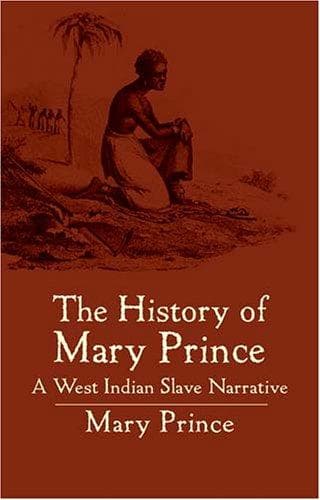
The History of Mary Prince, a West Indian Slave — John Shaqi
The History of Mary Prince, a West Indian SlavePrince, Mary
History
The History of Mary Prince, a West Indian Slave
Prince, Mary
Fugitive slaves -- West Indies -- Biography; Prince, Mary; Slavery -- West Indies
Supposing this fact be true, (which I doubt, as I doubt every mere
assertion from so questionable a quarter,) I shall take leave to put a
question or two to Mr. Wood's conscience. Did he not write from England to
his friend Mr. Darrel, soon after Mary left his house, directing him to
turn her husband, Daniel James, off his premises, on account of her
offence; telling him to inform James at the same time that his wife had
_taken up_ with another man, who had robbed her of all she had--a calumny
as groundless as it was cruel? I further ask if the person who invented
this story (whoever he may be,) was not likely enough to impose similar
fabrications on the poor negro man's credulity, until he may have been
induced to prove false to his marriage vows, and to "take another wife,"
as Mr. Wood coolly expresses it? But withal, I strongly doubt the fact of
Daniel James' infidelity; for there is now before me a letter from himself
to Mary, dated in April 1830, couched in strong terms of conjugal
affection; expressing his anxiety for her speedy return, and stating that
he had lately "received a grace" (a token of religious advancement) in the
Moravian church, a circumstance altogether incredible if the man were
living in open adultery, as Mr. Wood's assertion implies.
8. Mary, he says, endeavoured to injure the character of his family by
infamous falsehoods, which were embodied in a petition to the House of
Commons, and would have been presented, had not his friends from Antigua,
the Hon. Mr. Byam, and Dr. Coull, disproved her assertions.
I can say something on this point from my own knowledge. Mary's petition
contained simply a brief statement of her case, and, among other things,
mentioned the treatment she had received from Mr. and Mrs. Wood. Now the
principal facts are corroborated by other evidence, and Mr. Wood must
bring forward very different testimony from that of Dr. Coull before
well-informed persons will give credit to his contradiction. The value of
that person's evidence in such cases will be noticed presently. Of the
Hon. Mr. Byam I know nothing, and shall only at present remark that it is
not likely to redound greatly to his credit to appear in such company.
Furthermore, Mary's petition _was_ presented, as Mr. Wood ought to know;
though it was not discussed, nor his conduct exposed as it ought to have
been.
9. He speaks of the liability he should incur, under the Consolidated
Slave Law, of dealing with a free person as a slave.
Is not this pretext hypocritical in the extreme? What liability could he
possibly incur by voluntarily resigning the power, conferred on him by an
iniquitous colonial law, of re-imposing the shackles of slavery on the
bondwoman from whose limbs they had fallen when she touched the free soil
of England?--There exists no liability from which he might not have been
easily secured, or for which he would not have been fully compensated.
Public-domain text, read in full here on John Shaqi.
Reviews
Reviews
No reviews yet
Be the first to share your thoughts on this work.
Join the Discussion
Join the discussion
Sign in to leave a comment or review.
Sign InorCreate an account