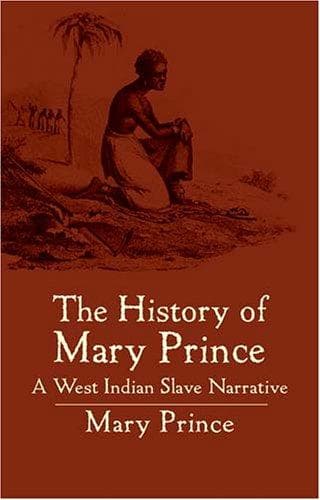
The History of Mary Prince, a West Indian SlavePrince, Mary
History
The History of Mary Prince, a West Indian Slave
Prince, Mary
Fugitive slaves -- West Indies -- Biography; Prince, Mary; Slavery -- West Indies
But there may be some persons into whose hands this tract may fall, so
imperfectly acquainted with the real character of Negro Slavery, as to be
shocked into partial, if not absolute incredulity, by the acts of inhuman
oppression and brutality related of Capt. I---- and his wife, and of Mr.
D----, the salt manufacturer of Turk's Island. Here, at least, such
persons may be disposed to think, there surely must be _some_
exaggeration; the facts are too shocking to be credible. The facts are
indeed shocking, but unhappily not the less credible on that account.
Slavery is a curse to the oppressor scarcely less than to the oppressed:
its natural tendency is to brutalize both. After a residence myself of six
years in a slave colony, I am inclined to doubt whether, as regards its
_demoralizing_ influence, the master is not even a greater object of
compassion than his bondman. Let those who are disposed to doubt the
atrocities related in this narrative, on the testimony of a sufferer,
examine the details of many cases of similar barbarity that have lately
come before the public, on unquestionable evidence. Passing over the
reports of the Fiscal of Berbice,[23] and the Mauritius horrors recently
unveiled,[24] let them consider the case of Mr. and Mrs. Moss, of the
Bahamas, and their slave Kate, so justly denounced by the Secretary for
the Colonies;[25]--the cases of Eleanor Mead,[26]--of Henry
Williams,[27]--and of the Rev. Mr. Bridges and Kitty Hylton,[28] in
Jamaica. These cases alone might suffice to demonstrate the inevitable
tendency of slavery as it exists in our colonies, to brutalize the master
to a truly frightful degree--a degree which would often cast into the
shade even the atrocities related in the narrative of Mary Prince; and
which are sufficient to prove, independently of all other evidence, that
there is nothing in the revolting character of the facts to affect their
credibility; but that on the contrary, similar deeds are at this very time
of frequent occurrence in almost every one of our slave colonies. The
system of coercive labour may vary in different places; it may be more
destructive to human life in the cane culture of Mauritius and Jamaica,
than in the predial and domestic bondage of Bermuda or the Bahamas,--but
the spirit and character of slavery are every where the same, and cannot
fail to produce similar effects. Wherever slavery prevails, there will
inevitably be found cruelty and oppression. Individuals who have preserved
humane, and amiable, and tolerant dispositions towards their black
dependents, may doubtless be found among slave-holders; but even where a
happy instance of this sort occurs, such as Mary's first mistress, the
kind-hearted Mrs. Williams, the favoured condition of the slave is still
as precarious as it is rare: it is every moment at the mercy of events;
and must always be held by a tenure so proverbially uncertain as that of
human prosperity, or human life. Such examples, like a feeble and
Public-domain text, read in full here on John Shaqi.
Reviews
Reviews
No reviews yet
Be the first to share your thoughts on this work.
Elsewhere in the archive
Join the Discussion
Join the discussion
Sign in to leave a comment or review.
Sign InorCreate an account