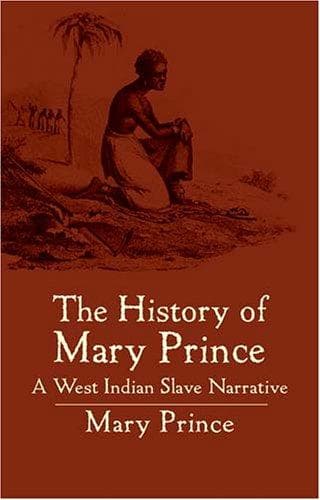
The History of Mary Prince, a West Indian SlavePrince, Mary
History
The History of Mary Prince, a West Indian Slave
Prince, Mary
Fugitive slaves -- West Indies -- Biography; Prince, Mary; Slavery -- West Indies
At length the vendue master, who was to offer us for sale like sheep or
cattle, arrived, and asked my mother which was the eldest. She said
nothing, but pointed to me. He took me by the hand, and led me out into
the middle of the street, and, turning me slowly round, exposed me to the
view of those who attended the vendue. I was soon surrounded by strange
men, who examined and handled me in the same manner that a butcher would a
calf or a lamb he was about to purchase, and who talked about my shape and
size in like words--as if I could no more understand their meaning than
the dumb beasts. I was then put up to sale. The bidding commenced at a few
pounds, and gradually rose to fifty-seven,[1] when I was knocked down to
the highest bidder; and the people who stood by said that I had fetched a
great sum for so young a slave.
[Footnote 1: Bermuda currency; about L38 sterling.]
I then saw my sisters led forth, and sold to different owners; so that we
had not the sad satisfaction of being partners in bondage. When the sale
was over, my mother hugged and kissed us, and mourned over us, begging of
us to keep up a good heart, and do our duty to our new masters. It was a
sad parting; one went one way, one another, and our poor mammy went home
with nothing.[2]
[Footnote 2: Let the reader compare the above affecting account, taken
down from the mouth of this negro woman, with the following description of
a vendue of slaves at the Cape of Good Hope, published by me in 1826, from
the letter of a friend,--and mark their similarity in several
characteristic circumstances. The resemblance is easily accounted for:
slavery wherever it prevails produces similar effects.--"Having heard that
there was to be a sale of cattle, farm stock, &c. by auction, at a
Veld-Cornet's in the vicinity, we halted our waggon one day for the
purpose of procuring a fresh spann of oxen. Among the stock of the farm
sold, was a female slave and her three children. The two eldest children
were girls, the one about thirteen years of age, and the other about
eleven; the youngest was a boy. The whole family were exhibited together,
but they were sold separately, and to different purchasers. The farmers
examined them as if they had been so many head of cattle. While the sale
was going on, the mother and her children were exhibited on a table, that
they might be seen by the company, which was very large. There could not
have been a finer subject for an able painter than this unhappy group. The
tears, the anxiety, the anguish of the mother, while she met the gaze of
the multitude, eyed the different countenances of the bidders, or cast a
heart-rending look upon the children; and the simplicity and touching
sorrow of the young ones, while they clung to their distracted parent,
wiping their eyes, and half concealing their faces,--contrasted with the
marked insensibility and jocular countenances of the spectators and
purchasers,--furnished a striking commentary on the miseries of slavery,
Public-domain text, read in full here on John Shaqi.
Reviews
Reviews
No reviews yet
Be the first to share your thoughts on this work.
Join the Discussion
Join the discussion
Sign in to leave a comment or review.
Sign InorCreate an account