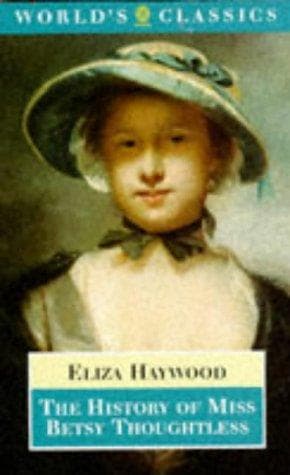
The History of Miss Betsy ThoughtlessHaywood, Eliza Fowler
General
The History of Miss Betsy Thoughtless
Haywood, Eliza Fowler
Abused wives -- Fiction; Bildungsromans; Didactic fiction; England -- Fiction; Married women -- Fiction
Before his departure, he went to the boarding-school, to take his leave
of his beloved Betsy, and renew the charge he had frequently given the
governess concerning her education; adding, in a mournful accent, that
it would be a long time before he saw her again.
These words, as it proved, had somewhat of prophetick in them. On his
arrival in London, he found his cause in so perplexed and entangled a
situation, as gave him little hopes of ever bringing it to a favourable
issue. The vexation and fatigue he underwent on this account, joined
with the closeness of the town air, which had never agreed with his
constitution even in his younger years, soon threw him into that sort of
consumption which goes by the name of a galloping one, and, they say, is
the most difficult of any to be removed. He died in about three months,
without being able to do any great matters concerning the affair which
had drawn him from his peaceful home, and according to all probability
hastened his fate. Being perfectly sensible, and convinced of his
approaching dissolution, he made his will, bequeathing the bulk of his
estate to him whose right it was, (his eldest son) then upon his travels
through the greatest part of Europe; all his personals, which were very
considerable in the Bank, and other public funds, he ordered should be
equally divided between Francis his second son, (at that time a student
at Oxford) and Miss Betsy; constituting, at the same time, as trustees
to the said testament, Sir Ralph Trusty, his near neighbour in the
country, and Mr. Goodman, a wealthy merchant in the city of London; both
of them gentlemen of unquestionable integrity, and with whom he had
preserved a long and uninterrupted friendship.
On the arrival of this melancholy news, Miss Betsy felt as much grief as
it was possible for a heart so young and gay as hers to be capable of;
but a little time, for the most part, serves to obliterate the memory of
misfortunes of this nature, even in persons of a riper age; and had Miss
Betsy been more afflicted than she was, something happened soon after
which would have very much contributed to her consolation.
Mr. Goodman having lived without marrying till he had reached an age
which one should have imagined would have prevented him from thinking of
it at all, at last took it into his head to become a husband. The person
he made choice of was called Lady Mellasin, relict of a baronet, who
having little or no estate, had accepted of a small employment about the
court, in which post he died, leaving her ladyship one daughter, named
Flora, in a very destitute condition. Goodman, however, had wealth
enough for both, and consulted no other interest than that of his heart.
Public-domain text, read in full here on John Shaqi.
Reviews
Reviews
No reviews yet
Be the first to share your thoughts on this work.
Join the Discussion
Join the discussion
Sign in to leave a comment or review.
Sign InorCreate an account