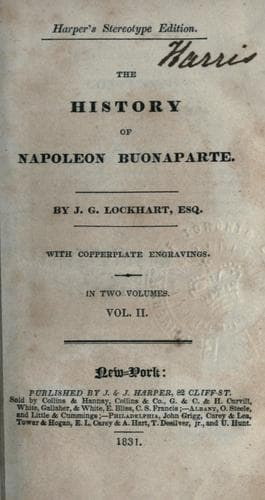
The History of Napoleon BuonaparteLockhart, J. G. (John Gibson)
History
The History of Napoleon Buonaparte
Lockhart, J. G. (John Gibson)
France -- Kings and rulers -- Biography; Napoleon I, Emperor of the French, 1769-1821
directions by English ships of war, in whose presence resistance would
have been hopeless. He occupied his time, during this period of general
anxiety, in very peaceful studies: he read the Bible, the Koran, Homer;
conversed with his _savans_ on the old times and manners of the East;
and solved problems in geometry. He also spent many hours in playing at
the game of _vingt-un_; and M. de Bourienne says, that he never
hesitated to play unfairly when it suited his purpose, though he always
returned whatever he had gained on rising from the table. On the 30th of
September they reached Ajaccio, and he was received with enthusiasm at
the place of his birth. But, according to his own phrase, "it rained
cousins:" he was wearied with solicitations, and as soon as the wind
proved favourable, on the 7th of October, the voyage was resumed.
Gantheaume, descrying an English squadron off the French coast, would
have persuaded him to take to the long-boat; but he refused, saying,
"that experiment may be reserved for the last extremity." His confidence
in fortune was not belied. They passed at midnight, unseen, through the
English ships, and on the morning of the 9th were moored in safety in
the bay of Frejus; and no sooner was it known that Buonaparte was at
hand, than, in spite of all the laws of quarantine, persons of every
description, including the chief functionaries, both civil and military,
repaired on board to welcome him. He had looked forward with the utmost
disgust to a long quarantine: this dread was dissipated in a moment; the
deck was crowded with persons, crying aloud, "We prefer the plague to
the Austrians!" His presence alone was considered as the pledge of
victory. The story of Aboukir gave new fuel to the flame of universal
enthusiasm; and he landed, not so much like a general who had quitted
his post without orders, as a victorious prince, who had returned to
restore the lost hearts and fortunes of a people that confided only in
him. His progress towards the capital, wherever his person was
recognised, bore all the appearance of a triumphal procession. He
reached his own house, in the _Rue de la Victoire_, on the 16th October.
The trembling Directory received him, when he presented himself at the
Luxembourg, with every demonstration of joy and respect. Not a question
was asked as to his abandonment of his army; for all dreaded the answer
which they had the best reason for anticipating. He was invited to
accept of a public dinner, and agreed to do so. The assemblage was
magnificent, and his reception enthusiastic; but his demeanour was cold
and reserved. After proposing as a toast, "the union of all
parties"--ominous words from those lips--he withdrew at an early hour of
the evening.
Public-domain text, read in full here on John Shaqi.
Reviews
Reviews
No reviews yet
Be the first to share your thoughts on this work.
Elsewhere in the archive
Join the Discussion
Join the discussion
Sign in to leave a comment or review.
Sign InorCreate an account