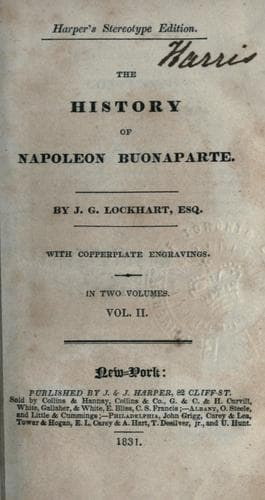
The History of Napoleon BuonaparteLockhart, J. G. (John Gibson)
History
The History of Napoleon Buonaparte
Lockhart, J. G. (John Gibson)
France -- Kings and rulers -- Biography; Napoleon I, Emperor of the French, 1769-1821
He continued for some little time to avoid public notice, resuming
apparently the same studious and sequestered life which he had led when
last in Paris. It was, however, remarked that, when recognised by the
populace, he received their salutations with uncommon affability; and
that if he met any old soldier of the army of Italy, he rarely failed to
recollect the man, and take him by the hand.
Buonaparte had been tormented when in Egypt by certain rumours
concerning the conduct of Josephine in his absence from Paris. She had
quitted the capital with the purpose of meeting him on his journey
thither, the moment his arrival at Frejus was known; but taking the road
of Burgundy, while he was travelling by that of Lyons, missed him. When
she at length joined him in Paris, he received her with marked coldness;
but, after a few days, the intercessions and explanations of friends
restored harmony between them. He felt acutely, says De Bourienne, the
ill effects which a domestic fracas must produce at the moment when all
France was expecting him to take the chief part in some great political
revolution.
The universal enthusiasm which waited on his person at this crisis
appears to have at length given definite shape to his ambition. All
parties equally seemed to be weary of the Directory, and to demand the
decisive interference of the unrivalled soldier. The members of the
tottering government were divided bitterly among themselves; and the
_moderates_, with the Director Sieyes at their head, on the one side,
the _democrats_, under the Director Barras, on the other, were equally
disposed to invoke his assistance. He received the proposals of both
parties; and at length decided on closing with those of the former, as
consisting of a class of men less likely than the others to interfere
with his measures--when the new government, which he had determined
should be _his_, had been arranged. His brother Lucien, recently elected
President of the Council of Five Hundred--the acute and spirited Abbé
Sieyes, for whom, as "a man of systems," Buonaparte had formerly
manifested great repugnance, but who was now recommended effectually by
his supposed want of high ambition--and Fouché, minister of
police--these were his chief confidants; nor could any age or country
have furnished instruments more admirably qualified for his purpose.
Josephine, too, exerted indefatigably in his cause all the arts of
address, and contrived to neutralise by flattery many whom promises had
failed to gain. Meanwhile his house was frequented by the principal
officers who had accompanied him from Egypt, and by others who had
served in his Italian campaigns; and though no one pretended to say what
was about to happen, the impression became universal throughout Paris,
that some great and decisive event was at hand, and that it was to be
brought about by means of Buonaparte.
Public-domain text, read in full here on John Shaqi.
Reviews
Reviews
No reviews yet
Be the first to share your thoughts on this work.
Elsewhere in the archive
Join the Discussion
Join the discussion
Sign in to leave a comment or review.
Sign InorCreate an account