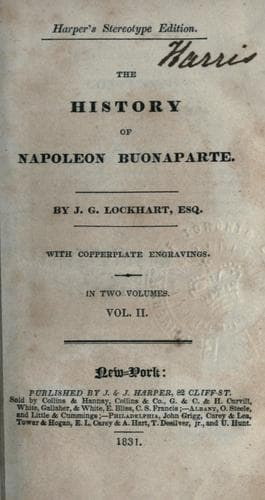
The History of Napoleon BuonaparteLockhart, J. G. (John Gibson)
History
The History of Napoleon Buonaparte
Lockhart, J. G. (John Gibson)
France -- Kings and rulers -- Biography; Napoleon I, Emperor of the French, 1769-1821
On the evening of the 17th Brumaire all the officers above-mentioned
received, separately, the General's invitation to come to his house in
the _Rue de la Victoire_, at six o'clock the next morning; and the three
regiments of dragoons were desired to be mounted for their review, at
the same early hour, in the _Champs Elysées_. How many of these persons
knew the real purpose of the assemblage it is impossible to tell; but
Moreau, Macdonald, and other generals of the first reputation, avowedly
attached to the _moderés_, were in the number of those who
attended,--having, it is not to be doubted, received sufficient
intimation that the crisis was at hand, though not of the manner in
which Buonaparte designed it to terminate. However, at the appointed
hour, the dragoons were at their post in the Champs Elysées; and the
concourse of officers at Napoleon's residence was so great that, the
house being small, he received them in the courtyard before it, which
they entirely filled.
Among those who came thither was Bernadotte; but he certainly came
without any precise notion of the purposes of his friend Joseph
Buonaparte, who invited him. He was, next to Napoleon, the general who
possessed the greatest influence at the period in Paris; in fact, the
fate of the government depended on whether the one party in the
Directory should be the first to summon him to interfere, or the others
to throw themselves on Buonaparte. He came; but, unlike the rest, he
came _not_ in uniform, nor on horseback. Being introduced into
Napoleon's private chamber, he was informed, with little preface, that a
change in the government was necessary, and about to be effected that
very day. Bernadette had already been tampered with by Sieyes and Ducos,
and he rejected Napoleon's flatteries as he had theirs. It was well
known to Buonaparte that, had this great officer's advice been taken, he
would, immediately on his arrival from Egypt, have been arrested as a
deserter of his post: he in vain endeavoured now to procure his
co-operation; and at last suffered him to depart, having with difficulty
extorted a promise, that he would not, at least, do anything against him
_as a citizen_. It will soon be seen that he could have little reason to
apprehend Bernadotte' s interference in his military capacity.
Public-domain text, read in full here on John Shaqi.
Reviews
Reviews
No reviews yet
Be the first to share your thoughts on this work.
Elsewhere in the archive
Join the Discussion
Join the discussion
Sign in to leave a comment or review.
Sign InorCreate an account