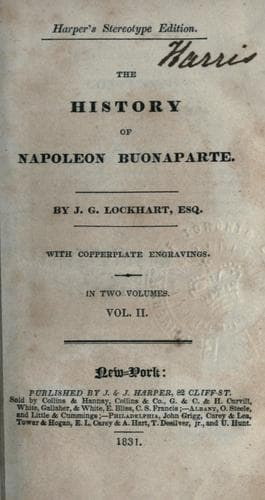
The History of Napoleon BuonaparteLockhart, J. G. (John Gibson)
History
The History of Napoleon Buonaparte
Lockhart, J. G. (John Gibson)
France -- Kings and rulers -- Biography; Napoleon I, Emperor of the French, 1769-1821
His friends at first busied themselves with schemes for making him one
of the directorial body; but the law, requiring that every candidate for
that office should be forty years of age, still subsisted; and this
presented an obstacle which Napoleon chose rather to avoid than to
overcome. The conspirators in his confidence were from day to day more
numerous, and, before he had been three weeks in Paris, audacity reached
its height. "During this crisis" (writes Bourienne) "there occurred
nothing a whit more elevated, more grand, more noble, than had been
observed in our preceding revolutionary commotions. In these political
intrigues, all is so despicable--so made up of trickery, lying, spying,
treachery, and impudence--that for the honour of human nature the
details ought to be buried under an eternal veil."
Sieyes governed absolutely one of his colleagues in the Directory,
Ducos; and the party of which he was the chief predominated strongly, as
has been mentioned, in the Council of Ancients. It was through the
instrumentality of that council, accordingly, that the conspirators
resolved to strike their first blow. And how well their measures had
been preconcerted, will sufficiently appear from the most naked
statement of the events of the 18th and 19th Brumaire (Nov. 10 and 11,
1799), in the order of their occurrence.
As soon as Buonaparte's arrival was known, three regiments of dragoons,
forming part of the garrison of Paris, petitioned for the honour of
being reviewed by him. He had promised to do this, but delayed naming
the day. In like manner the forty adjutants of the National Guard of
Paris (which, as we have seen, was remodelled by himself while General
of the Interior) had requested leave to wait upon him, and congratulate
him on his arrival: these also had been told that he would soon appoint
the time for receiving them. Lastly, the officers of the garrison, and
many besides, had sent to beg admittance to Napoleon's presence, that
they might tender him the expression of their admiration and attachment;
and to them also an answer of the same kind had been given.
Public-domain text, read in full here on John Shaqi.
Reviews
Reviews
No reviews yet
Be the first to share your thoughts on this work.
Elsewhere in the archive
Join the Discussion
Join the discussion
Sign in to leave a comment or review.
Sign InorCreate an account