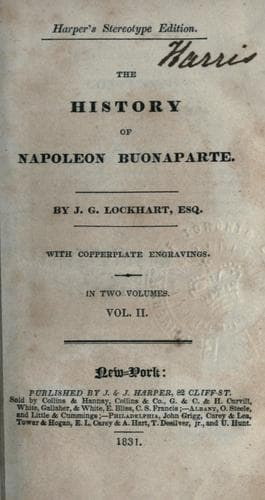
The History of Napoleon BuonaparteLockhart, J. G. (John Gibson)
History
The History of Napoleon Buonaparte
Lockhart, J. G. (John Gibson)
France -- Kings and rulers -- Biography; Napoleon I, Emperor of the French, 1769-1821
The upper population of Paris had watched the stormy days of the 18th
and 19th Brumaire with the most anxious fears, lest the end should be
anarchy and the re-establishment of the reign of terror. Such, in all
likelihood, must have been the result, had Buonaparte failed, after once
attempting to strike his blow. His success held out the prospect of
victory abroad, and of a firm and stable government at home, under which
life and property might exist in safety; and wearied utterly with so
many revolutions and constitutions, each in turn pretending everything,
and ending in nothing but confusion, the immense majority of the nation
were well prepared to consider any government as a blessing which seemed
to rest on a solid basis, and to bid fair for endurance. The
revolutionary fever had in most bosoms spent its strength ere now; and
Buonaparte found henceforth little opposition to any of his measures,
unless in cases where the substantial personal comforts of men--not
abstract theories or dogmas--nor even political rights of unquestionable
value and importance--were invaded by his administration.
The two chambers, on breaking up, appointed small committees to take
counsel during the recess with the new heads of the executive; and, in
concert with these, Buonaparte and Sieyes entered vigorously on the
great task of restoring confidence and peace at home. The confusion of
the finances was the most pressing of many intolerable evils; and the
first day was devoted to them. In lieu of forced loans, by which the
Directory had systematically scourged the people, all the regular taxes
were at once raised 25 per cent.; and the receipt and expenditure of the
revenue arranged on a business-like footing. The repeal of the "Law of
Hostages"--a tyrannical act, by which the relations of emigrants were
made responsible for the behaviour of their exiled kinsmen,--followed
immediately, and was received with universal approbation. A third and a
bolder measure was the discarding of the heathen ritual, and re-opening
of the churches for Christian worship; and of this the credit was wholly
Napoleon's, who had to oppose the _philosophic_ prejudices of almost all
his colleagues. He, in his conversations with them, made no attempt to
represent himself as a believer in Christianity; but stood on the
necessity of providing the people with the regular means of worship,
wherever it is meant to have a state of tranquillity. The priests who
chose to take the oath of fidelity to government were re-admitted to
their functions; and this wise measure was followed by the adherence of
not less than 20,000 of these ministers of religion, who had hitherto
languished in the prisons of France. Cambaceres, an excellent lawyer and
judge, was of great service to Napoleon in these salutary reforms.
Public-domain text, read in full here on John Shaqi.
Reviews
Reviews
No reviews yet
Be the first to share your thoughts on this work.
Elsewhere in the archive
Join the Discussion
Join the discussion
Sign in to leave a comment or review.
Sign InorCreate an account